
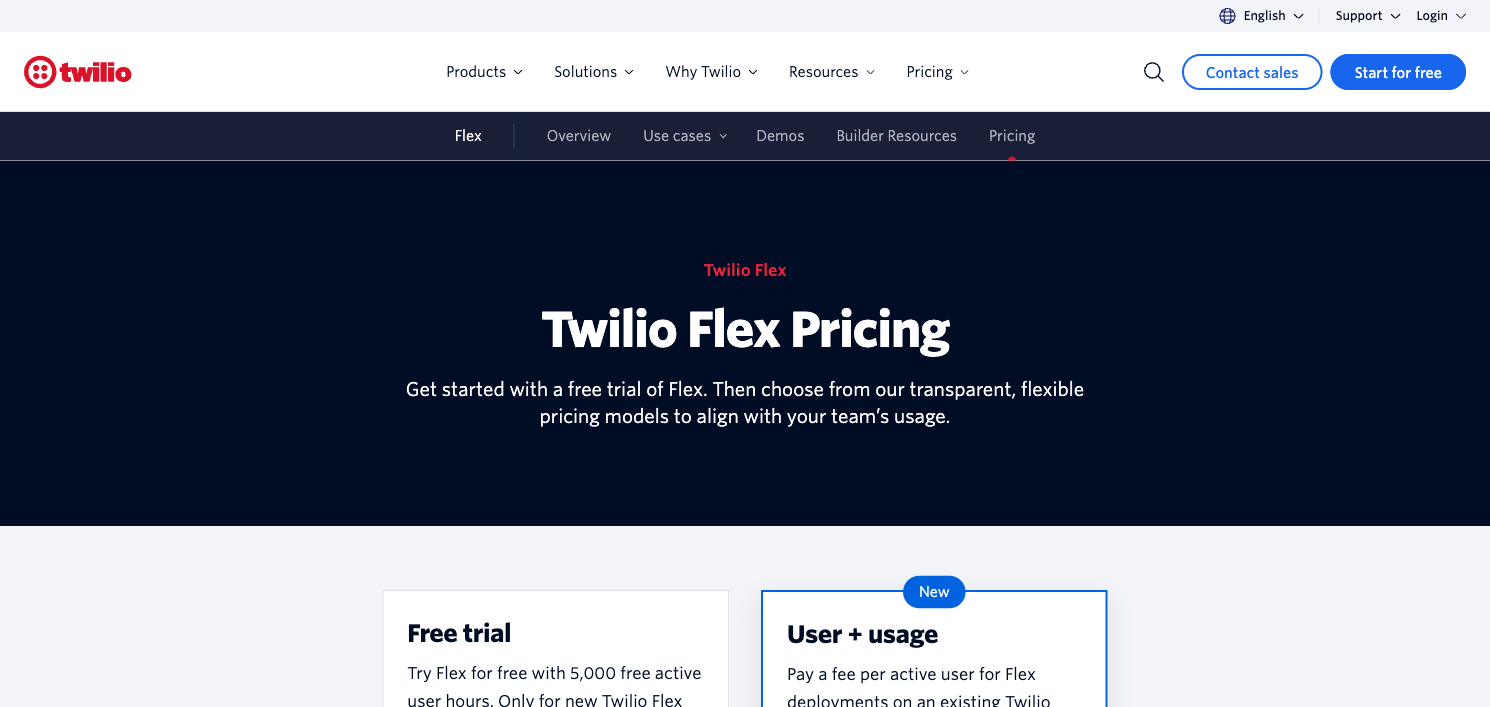
Twilio Flex offers three mutually exclusive pricing models on the same account: $1 per active user-hour, $150 per named user per month, or $35 per active user plus usage. The three models cannot mix on a single account. Mixing is explicitly disallowed in the Twilio Flex pricing documentation. The $35 plus usage model carries an additional restriction: it is available only to existing Twilio accounts, not to standalone Flex accounts. In April 2026, the Twilio Flex SDK shipped a headline integration: voice for Salesforce Agentforce Service. Twilio now powers the telephony layer for a Salesforce CCaaS product, even as Twilio competes with Salesforce in CPaaS. Twilio is a 2025 Gartner CPaaS Leader; Twilio Flex is NOT a 2025 Gartner CCaaS Leader.
This review covers what Twilio Flex is in 2026, how the three pricing models actually structure your cost, where the FedRAMP gap sits compared to Amazon Connect and Salesforce Government Cloud Plus, and the documented limitations every engineering-led evaluation should weigh.
Company facts: Twilio (NYSE: TWLO), Flex built on the CPaaS platform
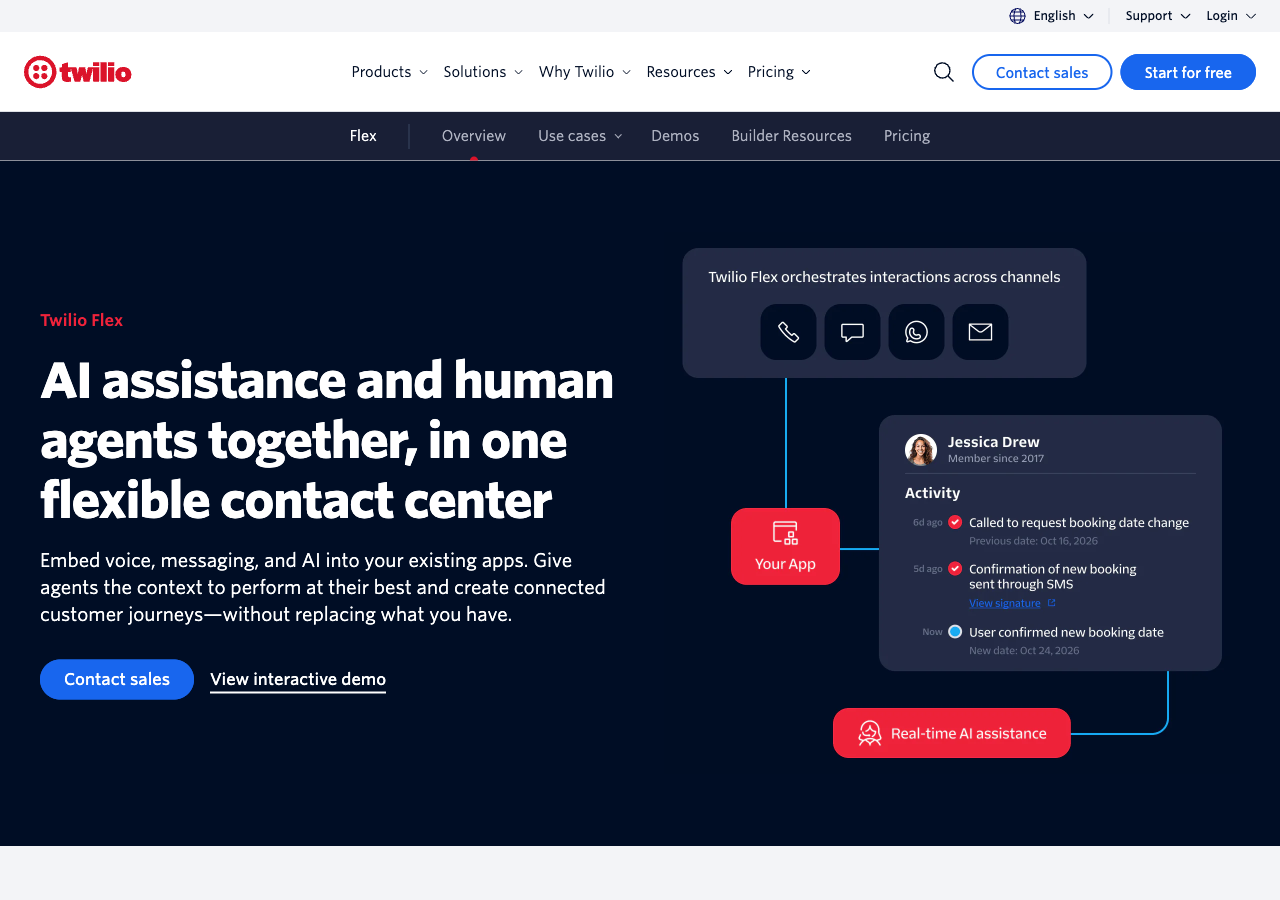
Twilio trades on NYSE under ticker TWLO. The company is headquartered in San Francisco. Twilio Flex is the contact center product built on top of Twilio’s CPaaS platform. Flex ships as a programmable agent desktop, routing engine, and integration surface that engineering teams customize through code rather than configuring through a packaged admin UI.
The Flex positioning is structural. Twilio is a CPaaS Leader on the 2025 Gartner CPaaS Magic Quadrant. The Flex product is the contact center surface on top of that CPaaS platform; it is not a packaged CCaaS competing on out-of-box feature parity with NICE CXone, Genesys Cloud CX, or Talkdesk.
For engineering-led organizations whose contact center experience is a competitive differentiator, the programmability is the entire point. You can replace any component, add any channel, and bend the data model to fit a non-standard business. For organizations wanting a packaged product with a finished admin experience, Twilio Flex requires engineering investment to reach feature parity.
Pricing: three mutually exclusive models
Twilio Flex publishes three pricing models. The mutual exclusivity is the structural detail every evaluation should weigh: you pick one model per account, and switching requires account changes.
| Model | Rate | Best fit | Restriction |
|---|---|---|---|
| Active user-hour | $1 per active user-hour | Variable utilization, high seat-to-utilization ratio | None |
| Named user | $150 per named user per month | Steady-state operations, predictable headcount | None |
| Platform + usage | $35 per active user plus usage fees | Existing Twilio accounts integrating contact center | Restricted to existing Twilio accounts only |
The $1 per active-user-hour model favors operations with uneven volume. A 100-agent contact center running 8-hour shifts with 50% average utilization pays for 400 active hours per day, or $400 per day. The same operation on the $150 per named-user model pays $15,000 per month flat, or $500 per day on a 30-day calendar. The active-hour model is materially cheaper for low-utilization operations.
The $150 per named-user model favors steady-state high-utilization operations. A 100-agent contact center running 80% utilization with predictable headcount pays $15,000 per month flat regardless of actual activity. The active-hour math at 80% utilization would run $1 × 640 active hours per day, or $19,200 per 30-day month.
The $35 per active user plus usage model targets existing Twilio accounts. Buyers without an existing Twilio relationship cannot access this tier. Verify your Twilio account status during evaluation.
SLA and compliance: SOC 2, ISO, PCI, HIPAA — but no FedRAMP
Twilio holds substantial compliance certifications across the Flex product:
- 99.95% uptime SLA with zero maintenance windows
- SOC 2 Type II
- ISO 27001
- ISO 27017 (cloud-specific information security)
- PCI DSS Level 1 and Level 4
- HIPAA-BAA
The structural gap: Twilio does NOT hold FedRAMP authorization. The absence is meaningful for US federal procurement.
For comparison, AWS Amazon Connect inherits FedRAMP authorization through AWS infrastructure. Salesforce Government Cloud Plus holds FedRAMP High plus DoD IL4 (the strongest federal posture in the field). NICE holds FedRAMP Moderate. Genesys holds FedRAMP. Twilio Flex sits structurally weaker on federal posture than these alternatives.
If your evaluation is federal-procurement-led, Twilio Flex requires written commitment from your Twilio account team on FedRAMP timeline before shortlisting. As of June 2026, the authorization has not surfaced publicly.
April 2026: Flex SDK powers Salesforce Agentforce Service voice
In April 2026, the Twilio Flex SDK shipped voice for Salesforce Agentforce Service as a headline integration. The development matters strategically: Twilio is now powering the telephony layer for Salesforce’s Agentforce Service product, even as Twilio’s broader CPaaS competes with Salesforce in messaging and AI APIs.
The integration depth: Twilio Flex SDK provides the voice runtime, recording, and transcription infrastructure under Salesforce’s Agentforce Service customer-facing surface. For Salesforce-anchored buyers evaluating Agentforce Service (formerly Service Cloud Voice, rebranded at Dreamforce ‘25 in October 2025), the underlying telephony provider is Twilio.
For your Twilio Flex evaluation, the strategic implication is roadmap durability. Twilio has positioned itself as a CCaaS partner to Salesforce rather than a CCaaS competitor. The roadmap investment in Flex continues, but Twilio is not betting against Salesforce in the CRM-native CCaaS battle. Buyers wanting a CCaaS that does not depend on Salesforce alignment should weigh this.
2025 Gartner positioning: CPaaS Leader, NOT CCaaS Leader
The September 8, 2025 Gartner CPaaS Magic Quadrant placed Twilio as a Leader. The September 8, 2025 Gartner CCaaS Magic Quadrant did NOT place Twilio Flex in the Leaders quadrant. The two placements are commonly conflated.
The 2025 CCaaS Leaders are NICE, Genesys, Five9, Talkdesk, and AWS Amazon Connect. Twilio Flex is not among them. For procurement evaluations specifically weighting CCaaS analyst recognition, Twilio Flex does not qualify as a 2025 Leader.
The CPaaS Leader placement is the relevant analyst signal for buyers evaluating Twilio Flex on programmable contact center merits rather than packaged CCaaS depth. If your evaluation criteria include “vendor must be a Gartner Leader” without specifying which Magic Quadrant, clarify the scope before shortlisting Twilio Flex.
Channel coverage and product portfolio
Twilio Flex covers inbound voice, outbound voice with dialer modes, email, web chat, SMS, WhatsApp Business API, and major social messaging through Twilio’s broader CPaaS API surface. The channel breadth depends on what engineering work you complete; out of the box, the channels are programmable rather than packaged.
The product surface in 2026 spans Twilio Flex (the contact center framework on CPaaS), Twilio Programmable Voice and Messaging (the underlying CPaaS), Twilio Segment (customer data platform), Twilio Engage (customer journey orchestration), and Twilio CustomerAI (the generative AI layer providing agent assist and self-service capabilities).
Twilio CustomerAI: generative AI on the programmable surface
Twilio CustomerAI extends Flex with generative agent assist, self-service capabilities, and AI Agent Copilot features. The product launched as the AI layer that raises the out-of-box floor for Flex without requiring custom build.
For buyers evaluating Flex specifically for AI features, Twilio CustomerAI is the relevant comparison point against Talkdesk Copilot (agentic since October 2025), NICE Enlighten ($328M FY2025 AI ARR +66%), and Genesys AI Experience ($1 per token consumption). Verify CustomerAI feature GA status and pricing during evaluation; Twilio does not publish CustomerAI rates as discrete line items at the Flex pricing page level.
Where Twilio Flex still falls short
A vendor-neutral review names the gaps. Twilio Flex has four documented limitations that should sit in your evaluation matrix.
Out of the box, Flex is building blocks rather than finished product. Engineering investment is required to reach feature parity with packaged CCaaS like NICE CXone, Genesys Cloud CX, or Talkdesk. Buyers without engineering capacity should look at the packaged Leaders instead.
No FedRAMP authorization. The gap is structural for US federal procurement compared to Amazon Connect (FedRAMP via AWS), Salesforce Government Cloud Plus (FedRAMP High plus DoD IL4), NICE (FedRAMP Moderate), or Genesys (FedRAMP).
Twilio Flex is not a 2025 Gartner CCaaS Leader. Twilio is a CPaaS Leader. The conflation of the two placements is a common buying error. Procurement evaluations weighting CCaaS analyst recognition should know the distinction.
WEM is largely partner-supplied. Verint, Calabrio, and Observe.AI integrate with Flex but Twilio does not ship a native WEM stack matching NICE or Genesys depth. Buyers prioritizing WFM, QM, and workforce analytics should plan for specialist add-on licensing.
How Twilio Flex compares with packaged CCaaS
Twilio Flex vs AWS Amazon Connect. Both engineering-led platforms. Amazon Connect is a 2025 Leader; Flex is not. Connect is per-minute consumption ($0.018-$0.038/min); Flex is per-active-hour or per-named-user. Connect inherits FedRAMP via AWS; Flex has no FedRAMP. Engineering teams familiar with AWS favor Connect; engineering teams familiar with Twilio CPaaS favor Flex.
Twilio Flex vs Salesforce Service Cloud (Agentforce Service). Flex provides programmable contact center; Service Cloud / Agentforce Service provides CRM-native CCaaS. April 2026 development: Flex SDK now powers Agentforce Service voice. The two products are increasingly aligned rather than competing for the same Salesforce-anchored buyer.
Twilio Flex vs Talkdesk. Talkdesk is a 2025 Leader with packaged CX Cloud product and Industry Experience Clouds. Flex is programmable framework on CPaaS. Talkdesk for packaged mid-market; Flex for engineering-led customization.
Twilio Flex vs Genesys Cloud CX. Genesys is a 2025 Leader with deep omnichannel routing and ISO/IEC 42001:2023 AI Management cert. Flex is programmable surface on CPaaS without packaged omnichannel depth. Genesys for enterprise packaged; Flex for build-your-own contact center.
The bottom line for an engineering-led evaluator
Twilio Flex is the structural pick when your contact center experience is a competitive differentiator, when engineering capacity is sufficient to build the desk your business needs, and when the Twilio CPaaS platform is already in your stack. The programmability is the entire point: replace any component, add any channel, bend the data model to fit your specific operation.
The cost is engineering investment, no FedRAMP authorization, no 2025 CCaaS Leader placement, and partner-supplied WEM rather than native depth.
For engineering-led organizations building bespoke contact center surfaces on top of CPaaS, Twilio Flex belongs on the shortlist. For non-engineering operations teams wanting packaged CCaaS or federal-procurement-led evaluations, Amazon Connect, Salesforce Service Cloud, or the 2025 CCaaS Leaders fit better.
Verify your pricing model selection (active-hour, named-user, or platform-plus-usage), the existing-Twilio-account restriction for the $35 model, and FedRAMP commitment timelines directly with your Twilio account team. The three pricing models are firm; mixing them on one account is explicitly disallowed.
Methodology
This review draws from the Twilio Flex official pricing page, the April 2026 Flex SDK launch documentation for Salesforce Agentforce Service voice, the Twilio Trust Center compliance summary, the September 2025 Gartner CPaaS Magic Quadrant placement.
Verification process: pricing models were verified directly on the Flex pricing page. Compliance posture was verified against the Twilio Trust Center. Gartner placement was verified for both the CPaaS Magic Quadrant (Leader) and the CCaaS Magic Quadrant (not a Leader).
For category context, see What is CCaaS and Cloud Contact Center. For 2025 Gartner CCaaS Leaders, see NICE, Genesys, Five9, Talkdesk, and Amazon Connect. For the Salesforce-aligned alternative, see Salesforce Service Cloud.
What each role sees on Twilio Flex
- Agent — handles voice, SMS, WhatsApp, chat, email and Facebook Messenger in the Twilio Flex agent UI, with the desktop built from React components that render Salesforce, HubSpot or custom CRM data on the same screen.
- Supervisor — monitors live queues and worker state in Flex Insights, listens in silently, coaches through whisper, and reassigns tasks across skills using Flex TaskRouter.
- QA analyst — runs Flex Conversational Intelligence for auto-transcription, scoring and sentiment analysis, reviews scorecards, and links coaching to the recorded interaction.
- WFM manager — integrates Flex with Calabrio ONE, Verint or NICE WFM through Flex Workflow APIs for forecasting, scheduling and adherence tracking.
- IT / telecom admin — programs channels, routing and integrations through the Twilio APIs, enforces SSO through the Flex identity plugin, and pays per active hour ($1) or per named user ($150) instead of a fixed seat license.
Unified agent desktop and cross-channel history
Twilio Flex is a programmable contact center: the agent desktop is a React app the team can extend with any customer-context widget, so a single pane can render Salesforce, a custom order-management screen and a WhatsApp thread side by side. Cross-channel context travels with the Twilio Conversation object; the supervisor sees the same threaded interaction in Flex Insights.
Estimate your Twilio Flex cost
Uses published $1.00/active-user-hour starting rate. Updates as you type.
Estimator uses vendor-published list rates as anchor. Actual quotes vary by add-ons (AI, WFM, dialer minutes) — request a written quote before signing.
Book a Twilio Flex demo
Vendor-facilitated. We forward your request to their sales team within 24 hours.
- Choose a preferred date + time slot
- 30-minute product walkthrough
- Custom pricing based on your seat count
Screenshots

Pros
- Fully programmable — every UI/workflow customisable
- Built on Twilio's global CPaaS network
- Hourly or per-seat pricing — choose what fits
Cons
- Requires developer skill to build the experience
- Out-of-the-box UX thinner than turnkey CCaaS
- WFM and QM via partner ecosystem
Similar Contact Center Core Tools
User Reviews
Write a reviewNo reviews yet for Twilio Flex.
Be the first to review