
Genesys is the only vendor in the 2025 Gartner CCaaS Leaders quadrant with an ISO/IEC 42001:2023 AI Management System certification publicly displayed. The Trust Center promotes the credential as a responsible-AI differentiator. Genesys also disclosed AI annual recurring revenue above $250 million in Q2 FY2026, with Genesys Cloud total ARR reaching approximately $2.2 billion, growing 35% year-over-year. Salesforce and ServiceNow jointly invested $1.5 billion in Genesys during 2024, ahead of a 2026 IPO targeting roughly $21 billion (S-1 paperwork was filed confidentially in October 2024).
This review covers what Genesys Cloud CX is in 2026, what the company actually publishes about pricing, how AI Experience consumption is metered, where the federal-procurement posture sits, and the documented limitations every enterprise evaluation should weigh.
Company facts: private, Menlo Park, origins in 1990
Genesys is a private enterprise software vendor headquartered in Menlo Park, California, with origins dating to 1990. The company was acquired by Permira and Hellman & Friedman in 2012. The current ownership group remains private equity through the 2026 IPO process.
Genesys Cloud CX is the company’s CCaaS suite. It launched in 2015 as PureCloud, a ground-up rebuild on AWS, and was later renamed Genesys Cloud CX. The platform shipped with the architectural advantages of a cloud-native build rather than an on-premise lift, and 11 years of continuous deployment have hardened the codebase.
The company’s older on-premise products, including Genesys Engage, remain in market for installed-base customers. Migration to Genesys Cloud CX is the strategic path Genesys sells to its on-premise customers. Specific Engage seat counts and migration completion percentages are not publicly disclosed.
Genesys markets more than 7,000 customers in over 100 countries. The figure is framed in vendor materials rather than audited. Verify the specific customer count for your evaluation rather than asserting the rounded marketing number.
Financial signal: $2.2B Cloud ARR, $250M AI ARR, 2026 IPO incoming
Genesys disclosed Cloud ARR around $2.2 billion in Q2 FY2026 with growth of approximately 35% year-over-year. AI ARR within that base sits above $250 million. The growth rate is meaningfully faster than overall CCaaS market growth, and the AI line item is the second-fastest publicly disclosed in CCaaS (after NICE’s $328M at 66%).
The strategic context matters for your procurement. Genesys filed S-1 paperwork confidentially with the SEC in October 2024. The expected IPO timeline is 2026, with a target valuation around $21 billion. Salesforce and ServiceNow jointly invested $1.5 billion in 2024, signaling that Salesforce is partnering with Genesys rather than building a standalone CCaaS to challenge the field directly.
If you sign a Genesys contract before the IPO closes, you are buying from a private vendor on the cusp of public-market transparency. Several procurement teams treat this as a positive signal. Others wait for the first public earnings call to verify the disclosed numbers under SEC scrutiny.
ISO/IEC 42001:2023 is the responsible-AI differentiator
Genesys holds an ISO/IEC 42001:2023 AI Management System certification. The credential surfaced on the public Trust Center compliance page in 2025 and is promoted as a responsible-AI governance differentiator. Genesys is the only 2025 Gartner CCaaS Leader with this certification publicly displayed.
The credential matters for evaluations led by AI governance teams, particularly in regulated industries (financial services, healthcare, public sector) and in EU jurisdictions where the AI Act is treated as a hard requirement. ISO 42001 covers AI risk management, transparency, accountability, and continuous improvement processes.
Buyers weighing AI governance posture in their shortlist should ask competing vendors directly whether they hold ISO 42001 or have committed to certification on a public timeline. As of June 2026, none of the other Leaders had matched Genesys on this credential publicly.
Pricing: CX 1 / 2 / 3 published, AI Experience metered per token
Genesys publishes per-seat pricing for the CX 1, CX 2, and CX 3 tiers on the official site. Specific dollar figures shift quarterly and should be verified directly with your Genesys account team or against the published page at evaluation time.
| Tier | Channels | AI included | Sales-gated |
|---|---|---|---|
| CX 1 | Voice + basic digital | No AI | Sales engagement for final quote |
| CX 2 | + Advanced digital | Limited AI | Sales engagement for final quote |
| CX 3 | + Full omnichannel + WEM | Bundled WEM | Sales engagement for final quote |
| AI Experience add-on | Across all tiers | Metered per $1 per token | Custom |
Third-party 2026 breakdowns cite CX 1 around $75 per seat, CX 2 around $115, CX 3 around $155, and a higher CX 4 SKU around $240 (the $240 figure is reported by third-party sources rather than directly verified on the Genesys official page). Treat these as planning estimates rather than firm rates.
The AI Experience pricing model is unusual. Genesys meters AI consumption at $1 per token rather than as a flat AI bundle. The model matters for your TCO: a 100-seat operation projecting 10,000 AI interactions per month carries a different cost shape than a 500-seat operation projecting 100,000. Model the token math against your projected AI workflow volume before signing.
Genesys does not publish exact AI token allocations per tier beyond the named/concurrent licensing baseline. Verify your specific allocation in the quote.
AppFoundry marketplace and integration depth
The Genesys AppFoundry marketplace lists integrations across CRM, helpdesk, identity, productivity, knowledge base, and AI overlay categories. CRM coverage includes Salesforce (deep integration following the 2024 $1.5B joint investment), Microsoft Dynamics, HubSpot, and Zoho. Helpdesk and ticketing covers Zendesk, ServiceNow, Jira, and Freshdesk. Identity supports Okta, Microsoft Entra ID, Google Workspace SSO, and federated providers.
Total AppFoundry size is not as publicly enumerated as RingCentral’s 500-plus App Gallery or Salesforce’s 600-plus AppExchange listings. Verify the specific connectors your operation depends on by name rather than relying on a marketplace count.
The Genesys-Salesforce relationship deserves specific attention. The $1.5 billion 2024 investment positions Salesforce Service Cloud Voice integration as a strategic priority on both vendor roadmaps. If you run Salesforce as your system of record, ask explicitly about Service Cloud Voice integration depth on Genesys Cloud CX during your evaluation.
Security and federal posture
Genesys holds FedRAMP authorization, qualifying the platform for US federal procurement. The Trust Center additionally lists SOC 2 (via HITRUST and ISO routes), PCI DSS, HIPAA-BAA, GDPR, and ISO 27001. The ISO/IEC 42001:2023 AI Management System certification covered earlier is the AI-specific credential.
The Genesys public compliance page does not enumerate SOC 2 Type II by name in the same explicit format as NICE, Five9, or Talkdesk. The credential appears via HITRUST and ISO 27001 cross-references rather than as a standalone badge. Buyers running strict SOC 2 Type II per-trust-criterion mapping should request specific scope documentation from their account team.
FedRAMP posture is comparable to NICE (FedRAMP Moderate) and AWS Amazon Connect (FedRAMP inherited via AWS). It is stronger than Five9 (GovRAMP membership only), RingCX (no public FedRAMP badge), and Twilio Flex (no FedRAMP). For federal-procurement-led evaluations, Genesys remains a defensible Tier 1 shortlist pick.
Channel coverage and product portfolio
Genesys Cloud CX covers the deepest channel set of any 2025 Leader: inbound voice, outbound voice with dialer modes, email, web chat, SMS, WhatsApp Business API, Apple Messages for Business, Facebook Messenger, Instagram Direct Messages, and major social messaging. Asynchronous channel routing handles conversations that pause and resume across days rather than treating each interaction as a fresh case.
Routing supports skills-based, attribute-based using CRM data, predictive based on customer history, and AI-driven based on real-time intent classification. Genesys positions predictive routing as a differentiator. The 2026 Virtual Agent product reportedly reached production-ready voice containment, moving past the deflection-only IVR replacements common a year earlier.
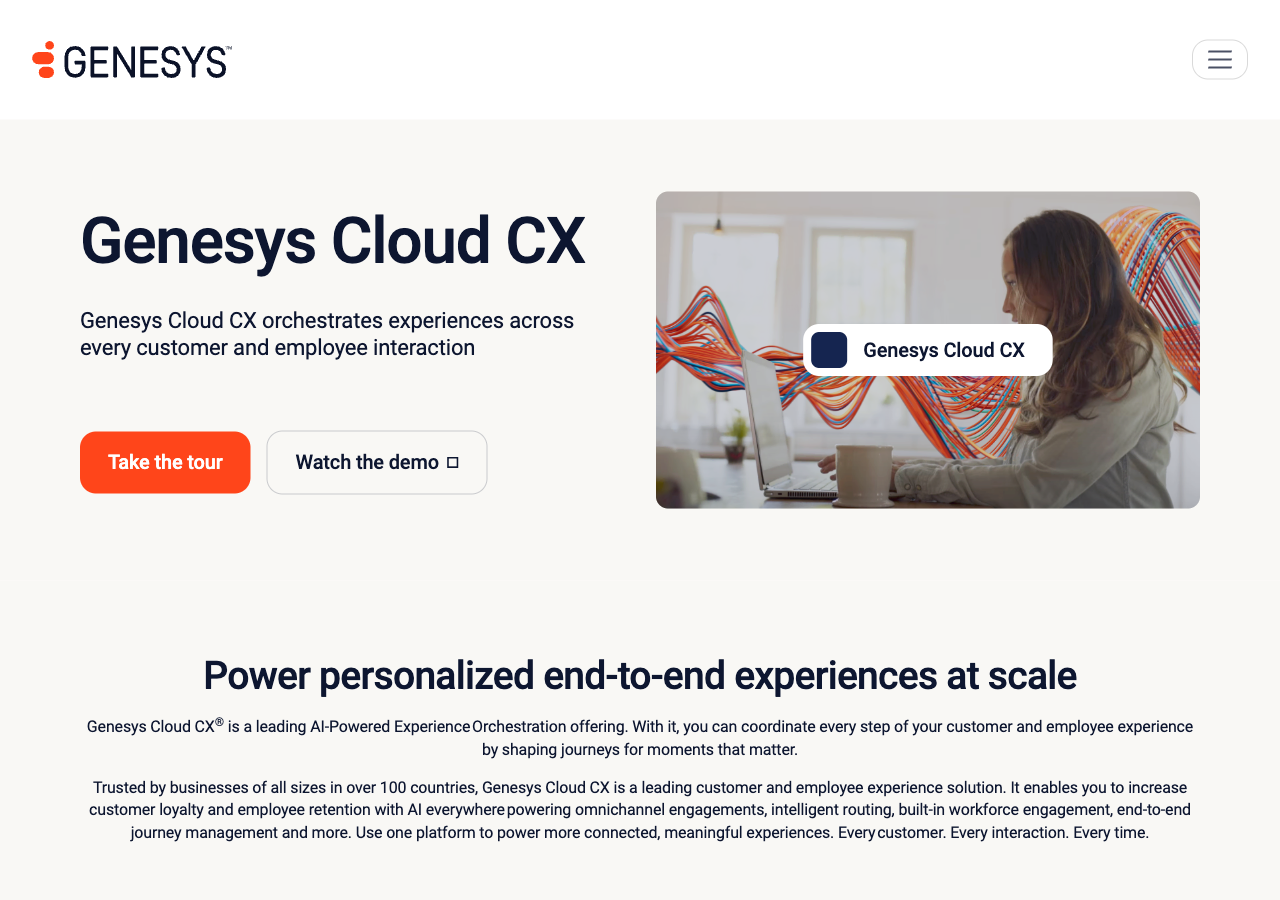
The product surface in 2026 spans Genesys Cloud CX Core (ACD, IVR, omnichannel), Genesys AI Experience (predictive routing, virtual agents, summarization, agent assist), workforce engagement management (forecasting, scheduling, quality, performance), and the recently expanded Virtual Agent product with vertical templates.
Where Genesys Cloud CX still falls short
A vendor-neutral review names the gaps. Genesys has four documented limitations that should sit in your evaluation matrix.
Pricing is a labyrinth of tiers. CX 1, CX 2, CX 3, AI Experience add-ons, and the rumored CX 4 SKU create complexity. The AppFoundry marketplace, while broad, still requires integrator effort for non-standard CRMs. Mid-market buyers report the pricing model takes longer to model than RingCX or Aircall.
The administrative UI rewards expertise. Small teams without a dedicated CCaaS admin will feel the learning curve. Genesys’s enterprise customer base runs dedicated platform admin functions; mid-market buyers should plan for the same operational overhead.
SOC 2 Type II surfaces via HITRUST and ISO routes rather than explicitly listed. Procurement reviews that require explicit per-trust-criterion SOC 2 mapping will need vendor confirmation on scope. Other Leaders (NICE, Five9, Talkdesk) list SOC 2 Type II as a standalone badge.
Private-company financial opacity until the 2026 IPO closes. Buyers signing multi-year contracts before public-market transparency arrives are buying on private-company disclosure standards. Once the IPO closes, quarterly earnings will normalize the comparison with NICE, Five9, and RingCentral.
How Genesys Cloud CX compares with the other 2025 Leaders
Genesys vs NICE CXone. Both 11-year Leaders. NICE leads on disclosed AI revenue growth (+66% vs +35% on Genesys Cloud ARR). Genesys holds the only public ISO/IEC 42001:2023 AI Management cert. Genesys meters AI per token; NICE meters per session at the upper tier. Both ship the deepest WEM stacks in the field. The choice often comes down to incumbent WEM investment and AI governance posture.
Genesys vs Five9. Genesys leads on omnichannel depth, WEM, and analyst recognition. Five9 leads on outbound dialer and TCPA tooling. Federal buyers favor Genesys because Five9 holds GovRAMP membership but not FedRAMP. Five9 publishes Digital $119 and Core $159 entry tiers; Genesys gates standard pricing.
Genesys vs Talkdesk. Both 2025 Leaders. Talkdesk entered the Leaders quadrant for the first time in 2025; Genesys has been a Leader 11 years running. Genesys leads on enterprise depth. Talkdesk leads on agent desktop UX and Industry Experience Clouds for vertical templates. Talkdesk requires a 3-year minimum on every tier.
Genesys vs AWS Amazon Connect. Both 2025 Leaders. Genesys is per-seat enterprise software; Amazon Connect is per-minute consumption ($0.018/min Basic, $0.038/min Customer with AI). The two pricing models target different operating-cost profiles. Amazon Connect’s no-seat-minimum economics work for highly variable volume; Genesys’s per-seat works for steady-state operations.
Implementation reality at enterprise scale
Genesys Cloud CX implementations land in the 4 to 9 month range for typical enterprise deployments. Greenfield mid-market deployments at 100 to 300 seats run 3 to 5 months. Complex migrations from Genesys Engage on-premise to Cloud CX routinely run 9 to 12 months elapsed.
The partner ecosystem covers regional and vertical specialization. Direct PS engagement is common for the largest enterprise accounts. Customer success cadence is structured: enterprise accounts above 500 seats typically receive quarterly business reviews; mid-market accounts receive semi-annual touches.
Change management is the long pole. Agent training on the Genesys Cloud CX desktop typically takes 4 to 8 hours per agent. Supervisor and admin training runs 2 to 4 days. Year-one operational stabilization usually takes 60 to 90 days post go-live.
The bottom line for an enterprise evaluator
Genesys Cloud CX is the conservative pick when omnichannel depth, AI governance posture, and analyst recognition matter most. The platform ships the deepest channel coverage in cloud CCaaS. ISO/IEC 42001:2023 AI Management certification is the only public responsible-AI credential in the Leaders quadrant. Disclosed AI ARR above $250 million and Cloud ARR around $2.2 billion verify financial momentum. The 2026 IPO will normalize public-market transparency.
The cost is enterprise complexity. Pricing is a multi-tier sales-gated structure. Implementation timelines stretch on complex migrations. Mid-market buyers under 100 seats often pick lighter-weight platforms because they do not need Genesys depth.
For enterprise contact center evaluations at 500-plus seats where omnichannel depth and AI governance drive the buying decision, Genesys Cloud CX should make every shortlist. For sub-200-seat evaluations, the comparison runs closer to NICE CXone, RingCX, or Talkdesk.
Verify current pricing and AI Experience token allocations with your Genesys account team. The published CX 1 / 2 / 3 structure is firm; the token model moves with negotiation.
Methodology
This review draws from the Genesys official Trust Center, the September 2025 Gartner Magic Quadrant for CCaaS press release issued by Genesys, the public disclosures around the 2026 IPO including the confidentially filed October 2024 S-1, the $1.5 billion 2024 investment announcement from Salesforce and ServiceNow, the AppFoundry marketplace.
Verification process: each pricing claim was cross-checked against the official site (where published) plus 2026 third-party breakdowns. AI ARR and Cloud ARR figures came from public investor disclosures. Compliance posture was verified against the Genesys Trust Center, including the ISO/IEC 42001:2023 certification.
For category context, see What is CCaaS and Cloud Contact Center. For head-to-head comparison, see Genesys vs NICE and Amazon Connect vs Genesys. For other 2025 Gartner Leaders, see NICE, Five9, Talkdesk, and Amazon Connect.
What each role sees on Genesys Cloud CX
- Agent — handles voice, email, chat, messaging, social and callbacks in the Genesys Cloud CX unified agent desktop with case data from Salesforce or ServiceNow (both strategic investors in Genesys) displayed inline.
- Supervisor — monitors queues, service levels and agent state in real time, coaches through whisper and barge, and reassigns interactions across skills-based routing groups from the same pane.
- QA analyst — runs Genesys AI Experience for auto-QA, scores conversations against custom evaluation forms, and links coaching sessions to the specific call recording.
- WFM manager — forecasts multi-channel volume in Genesys Workforce Engagement Management, publishes schedules against skills and shifts, and reforecasts against real-time actuals.
- IT / telecom admin — runs the platform on AWS-hosted Genesys Cloud, provisions PSTN across the Genesys global carrier footprint, enforces SSO through Okta, Microsoft Entra ID or Google, and inherits FedRAMP authorization.
Unified agent desktop and cross-channel history
Genesys Cloud CX threads voice, email, chat, messaging and social into one agent view with predictive engagement scoring who to reach and when. A customer who starts on chat and picks up the phone lands on the same agent with the full transcript already loaded; the supervisor sees the same journey and can route the next interaction to the right skill without breaking the flow.
Estimate your Genesys cost
Uses published $75.00/seat/mo starting rate. Updates as you type.
Estimator uses vendor-published list rates as anchor. Actual quotes vary by add-ons (AI, WFM, dialer minutes) — request a written quote before signing.
Book a Genesys demo
Vendor-facilitated. We forward your request to their sales team within 24 hours.
- Choose a preferred date + time slot
- 30-minute product walkthrough
- Custom pricing based on your seat count
Screenshots
Pros
- Deep omnichannel routing and AI capabilities
- Industry-leading workforce engagement suite
- AppFoundry marketplace with 350+ integrations
Cons
- Implementation complexity at enterprise scale
- Premium pricing relative to mid-market peers
- Migration from legacy Genesys Engage requires careful planning
Similar Contact Center Core Tools
User Reviews
Write a reviewNo reviews yet for Genesys.
Be the first to review