
NICE disclosed $328 million in AI annual recurring revenue for FY2025, growing 66% year-over-year. That is the fastest publicly disclosed AI revenue line in the contact center as a service category. Enlighten AI is sold across CXone tiers rather than as a premium add-on, narrowing the AI gap competitors had opened on price. NICE was named a Leader in the September 8, 2025 Gartner Magic Quadrant for CCaaS for the 11th consecutive year, positioned highest on Ability to Execute and furthest on Completeness of Vision.
This review covers what CXone is in 2026, what the verified pricing actually looks like (and what NICE will not publish), how the Enlighten AI traction shows up in earnings, where the federal-procurement posture sits, and the documented limitations every mid-market and enterprise evaluation should weigh.
Company facts: NASDAQ-listed and Israeli-headquartered
NICE Ltd. trades on NASDAQ under ticker NICE. The company is headquartered in Ra’anana, Israel, with US operations across multiple sites including its inContact-origin Utah hub. CXone, the company’s CCaaS suite, was built from the 2016 acquisition of inContact for approximately $960 million. The product was rebranded as NICE CXone after the acquisition and has been continuously rebuilt since.
NICE’s broader product surface predates CCaaS by decades. The company built the category-defining workforce management product before contact center as a service existed. That heritage shows in the CXone WFM stack: forecasting accuracy, schedule adherence tooling, intraday management, and quality scoring all run materially deeper than vendors that bolted WFM on later.
NICE does not disclose CXone-specific customer count publicly. Vendor-claimed figures vary across marketing materials. Open research questions remain on Mpower Agents named deployment metrics, on the Cognigy integration completion timeline that NICE announced in 2025, and on certain product-page customer counts that NICE has not surfaced in earnings.
Enlighten AI traction is clear disclosure
NICE’s AI brand is Enlighten. The product surface includes Enlighten Copilot for agents, Enlighten Autopilot for self-service, and Enlighten Actions for supervisors. All three are generally available as of 2026, with vendor-reported production deployment across multiple verticals.
The financial signal is what matters for your evaluation. NICE reported FY2025 AI ARR of $328 million, growing 66% year-over-year. The growth rate is the fastest publicly disclosed AI revenue line in the CCaaS category. Five9 disclosed $100 million in Enterprise AI ARR (+50% YoY). Genesys reported AI ARR above $250 million in Q2 FY2026. RingCentral reported $100 million in new-product ARR with pure AI ARR almost tripling year-over-year.
When you weight AI maturity in your shortlist, the test is whether the figure was disclosed in an earnings call or sourced from a marketing slide. NICE passes that test with a multi-quarter disclosure track record. Ask your account team for the most recent quarter’s Enlighten ARR breakdown during your evaluation.
CXone pricing is sales-gated; one government tier is uniquely published
NICE does not publish standard CXone tier pricing on its official website. Quotes require sales engagement, and contracts typically skew toward three-year commitments.
One specific tier is published. The CXone Government industry package is priced at $2 per consumer per year. The per-consumer pricing model is unique among CCaaS vendors, signaling a true business-to-government specialization rather than a generic enterprise discount. Buyers in US public sector should weight this explicitly in their evaluation matrix.
Third-party 2026 breakdowns cite Ultimate Suite tier pricing around $249 per agent per month with a $0.25 per-session uplift at the top of the AI bundle. The session uplift matters for any high-volume deployment: a 100-seat operation handling 200 sessions per agent per day could see add-on AI cost of $1,500 per agent per month on top of the $249 base. Model the session math against your projected interaction volume.
A handful of NICE product URLs return 404 to direct access, including /products/cxone-mpower and parts of /customers. Vendor URL discipline is poor. The information you need usually exists, but you may need to ask your account team rather than navigate from the home page.
Compliance is the enterprise differentiator
NICE holds FedRAMP Moderate authorization, one of the strongest federal cloud postures in the CCaaS field. The badge wall additionally lists SOC 2 Type II combined with HITRUST (a combined assessment rather than separate listings), PCI DSS, GDPR, HIPAA-BAA, and ISO 27001.
NICE also enumerates EU AI Act compliance on its certifications page. The disclosure is earlier than most peers, and it matters for European procurement teams treating the AI Act as a hard requirement.
The compliance posture is the practical answer to NICE’s enterprise-led positioning. If your evaluation is federal-procurement-led or regulated-industry-led (financial services, healthcare, public sector), NICE is structurally easier to procure against than Five9 (no FedRAMP), Talkdesk (FedRAMP tier unverified), or the privately held mid-market field.
Channel coverage and product portfolio
CXone covers the standard channel set at scale: inbound voice, outbound voice with dialer modes, email, web chat, SMS, WhatsApp Business API, Apple Messages for Business, and major social messaging. Routing supports skills-based, attribute-based using CRM data, and AI-predicted patterns.
The product surface in 2026 spans CXone Core (ACD, IVR, omnichannel routing), Enlighten AI (Copilot, Autopilot, Actions), the deep WEM stack (workforce management, quality management, performance management, analytics), and recently the Mpower Agents product NICE launched in 2025 to position against the agentic AI wave.
Genesys ships its product through a per-token AI Experience model. NICE bundles Enlighten across CXone tiers and meters per session at the upper tier. Both vendors have agentic AI roadmaps; the cost models differ enough to matter for high-volume operations.
The WEM stack is the strategic differentiator
NICE’s workforce engagement management depth is the structural argument for picking CXone over any other 2025 Leader. The competitive moat predates contact center as a service: NICE built and acquired the WFM, QM, and analytics products that defined the category before cloud existed.
Forecasting accuracy in CXone WFM consistently scores higher in analyst reviews than competitor bundled WFM. The scheduling engine handles multi-skill, multi-site, and multi-channel constraints. Schedule adherence tracking runs in near real-time. Intraday management surfaces variance alerts. Quality management auto-scores 100% of interactions through Enlighten, replacing the traditional 1-3% manual sampling that defined contact center QA for two decades.
The depth shows up in your operating cost model. A 500-agent operation running NICE WFM typically does not need to bolt on Verint, Calabrio, or Playvox. Vendors selling lighter CCaaS often pair with one of these specialist suites, adding $40 to $80 per seat per month in licensing on top of the base CCaaS cost. NICE bundles enough WEM depth that the specialist add-on becomes optional rather than mandatory.
If your operations leader spends their day in WFM, CXone will feel like home. If your operations function is light on WFM and heavy on simple inbound routing, the depth is overkill.
Integrations: the AppHub marketplace
NICE’s integration marketplace (AppHub or equivalent) covers the categories your contact center needs. CRM coverage includes Salesforce, Microsoft Dynamics, HubSpot, and Zendesk. Ticketing and helpdesk includes Zendesk, ServiceNow, Jira, and Freshdesk. Identity and SSO supports Okta, Microsoft Entra ID, and major federated identity providers.
Total marketplace size is not as publicly enumerated as RingCentral’s 500-plus App Gallery or Salesforce’s 600-plus AppExchange listings for Service Cloud. Verify the specific connectors you depend on by name before signing rather than relying on a marketplace count.
Customer evidence at enterprise scale
NICE markets to enterprise contact center buyers across financial services, healthcare, public sector, BPO, retail, and telecommunications. Customer case studies include named deployments with specific outcomes, though several were vendor-attributed rather than independently verified.
The 2025 Mpower Agents launch surfaced named customer deployments alongside the agentic AI positioning. Verify deployment metrics against the vendor’s reference customer list during your evaluation rather than relying on the case-study summary.
NICE does not disclose Mpower Agents customer count publicly. Verify with your account team rather than asserting a number from marketing materials.
Implementation reality at enterprise scale
CXone implementations land in the 4 to 9 month range for typical enterprise deployments. Greenfield mid-market deployments at 100 to 300 seats run 3 to 5 months. Complex multi-site migrations from on-premise NICE or Avaya estates routinely run 9 to 12 months elapsed.
NICE runs implementations through its own professional services organization and through a deep partner channel. Partner-led implementations cover regional specialization, vertical industry expertise (financial services, healthcare, public sector), and integration depth on specific CRM stacks. Direct PS engagement is common for the largest enterprise accounts. For deployments at your scale, ask about both paths during evaluation.
Customer success cadence is structured. Enterprise accounts above 500 seats typically get quarterly business reviews with named technical account managers. Mid-market accounts get semi-annual touches. Support tier escalation paths are documented and generally honored, though buyer-reported response times vary by region.
Change management is the long pole, as with any CCaaS migration. Agent training on the CXone desktop typically takes 4 to 8 hours per agent. Supervisor and admin training runs 2 to 4 days. Reporting habit rebuild takes 60 to 90 days for your team to stabilize.
Vendor risks and trends to monitor
Public-company financial transparency is a structural NICE advantage. Quarterly earnings disclose AI ARR, growth rates, and segment revenue at granularity that private competitors cannot match. The disclosure track record matters for your procurement: if NICE’s AI growth rate decelerates materially in a future quarter, you will see it.
Competitive pressure is intensifying. Genesys filed S-1 paperwork confidentially in October 2024 for a 2026 IPO targeting roughly $21 billion. Salesforce + ServiceNow jointly invested $1.5 billion in Genesys in 2024, signaling that Salesforce is partnering with Genesys rather than building a competing CCaaS to challenge NICE directly. Talkdesk entered the Leaders quadrant for the first time in 2025 and is investing heavily in agentic AI through October 2025’s Copilot upgrade.
The Cognigy integration NICE announced in 2025 is a strategic move into deeper conversational AI. The completion timeline and feature scope warrant verification with your account team. NICE has framed Cognigy as a partner-built capability rather than an acquired product.
Leading indicators a NICE buyer should monitor in their first contract year: quarterly Enlighten AI ARR disclosure rate (continued transparency signals strategic priority), the published Mpower Agents roadmap delivery rate versus committed dates, the CXone customer success engagement experience at your seat band, and any deceleration in the AI ARR growth rate from the current 66% YoY pace.
Where NICE CXone still falls short
A vendor-neutral review names the gaps. NICE has four documented limitations that should sit in your evaluation matrix.
The buying experience is opaque. Standard tier pricing is sales-gated. Contracts skew toward three-year commitments. Smaller deployments report the platform feels overbuilt for their needs. If you are evaluating CXone at 50 to 150 seats, expect a sales motion that NICE has optimized for 500-plus seat deployments.
The administrative surface is broad. CXone rewards expertise. Small teams without a dedicated CCaaS admin will feel the learning curve. NICE’s enterprise customers run dedicated admin functions; mid-market buyers should plan for the same.
Vendor URL discipline is poor. Critical product pages return 404 to direct access. The /products/cxone-mpower URL was reported broken in research. Parts of /customers redirect or 404. You will need to navigate via your account team rather than self-serve research.
SOC 2 Type II surfaces through a combined HITRUST assessment. The exact scope is less granular than vendors that list SOC 2 Type II separately. If your security review requires explicit per-trust-criterion SOC 2 mapping, allocate extra time for vendor confirmation.
How CXone compares with the other 2025 Leaders
CXone vs Genesys Cloud CX. Both 11-year Leaders. Both pricing-gated for standard tiers. NICE leads on disclosed AI revenue growth (+66% vs +35% on Genesys Cloud ARR). Genesys holds the only public ISO/IEC 42001:2023 AI Management System certification in the field. NICE holds FedRAMP Moderate; Genesys holds FedRAMP. Both are credible enterprise picks; the choice often comes down to incumbent WEM and analytics investment.
CXone vs Five9. NICE leads on omnichannel depth and WEM. Five9 leads on outbound dialer and TCPA tooling. Five9 publishes $119 Digital and $159 Core entry tiers with a 50-seat minimum. NICE gates standard pricing. Federal buyers favor NICE because Five9 holds GovRAMP membership but not FedRAMP.
CXone vs Talkdesk. NICE leads on disclosed AI revenue. Talkdesk leads on agent desktop UX and Industry Experience Clouds for Retail, Financial Services, and Healthcare. Talkdesk requires a 3-year minimum on every tier; NICE is comparable but less rigidly enforced.
CXone vs AWS Amazon Connect. Per-seat enterprise software (NICE) versus per-minute consumption model (Amazon Connect). Federal procurement posture is comparable: NICE holds FedRAMP Moderate, AWS inherits FedRAMP through AWS. Amazon Connect’s $0.018/min Basic and $0.038/min Customer with AI bundled is a different operating cost model from NICE’s per-agent licensing plus per-session AI uplift.
The bottom line for an enterprise evaluator
NICE CXone is the conservative pick when workforce management, quality management, and analytics are the strategic priority. The platform ships the deepest WEM stack in cloud CCaaS. Enlighten AI is sold across tiers rather than as a premium upsell. Disclosed AI revenue traction ($328M FY2025, +66% YoY) is verifiable evidence of customer adoption rather than a marketing claim. FedRAMP Moderate authorization unlocks federal procurement that several competitors cannot match.
The cost is enterprise complexity. Pricing is sales-gated. Contracts are long-cycle. Implementation timelines stretch on complex deployments. Mid-market buyers under 100 seats often pick lighter-weight platforms (RingCX at $65 to $145, Aircall at $30, Dialpad at $80 to $150) because they do not need the depth NICE ships.
For enterprise contact center evaluations at 500-plus seats where WFM and analytics drive the buying decision, NICE CXone should make every shortlist and is the structural favorite. For sub-200-seat evaluations where AI is the wedge but you do not need the full WEM stack, the comparison runs closer.
Verify current pricing and tier inclusions with your NICE account team. The published Government per-consumer rate is firm; everything else moves with negotiation.
Methodology
This review draws from NICE’s official Trust Center compliance page, the September 2025 Gartner Magic Quadrant for CCaaS press release issued by NICE, NICE’s FY2025 earnings disclosures including the $328M AI ARR figure, the official AppHub or AppExchange-equivalent integration listings.
Verification process: each pricing claim was cross-checked against the official site (where published) plus 2026 third-party breakdowns. AI ARR figures came from NICE earnings calls. Compliance posture was verified against the NICE Trust Center.
For category context, see What is CCaaS and Cloud Contact Center. For head-to-head comparison, see Genesys vs NICE. For other 2025 Gartner Leaders, see Genesys, Five9, Talkdesk, and Amazon Connect.
What each role sees on NICE CXone Mpower
- Agent — works from NICE CXone Mpower's unified agent desktop with Enlighten AI copilot suggesting next-best actions and CRM data pulled from Salesforce, ServiceNow or Microsoft Dynamics 365 on screen.
- Supervisor — watches live queues, SLA and agent state in the CXone Real-Time Interaction Guidance dashboard, coaches through whisper, and steps into a live call when Enlighten flags a struggling interaction.
- QA analyst — runs Enlighten AutoScoring across 100% of interactions in CXone Quality Central, reviews auto-generated scorecards, and links targeted coaching to the specific call recording.
- WFM manager — forecasts volume in NICE Workforce Management, publishes multi-skill multi-site schedules, and reruns intraday forecasts as actuals arrive.
- IT / telecom admin — provisions PSTN through the NICE global carrier footprint, enforces SAML SSO through Okta, Microsoft Entra ID or Ping Identity, and inherits FedRAMP Moderate authorization.
Unified agent desktop and cross-channel history
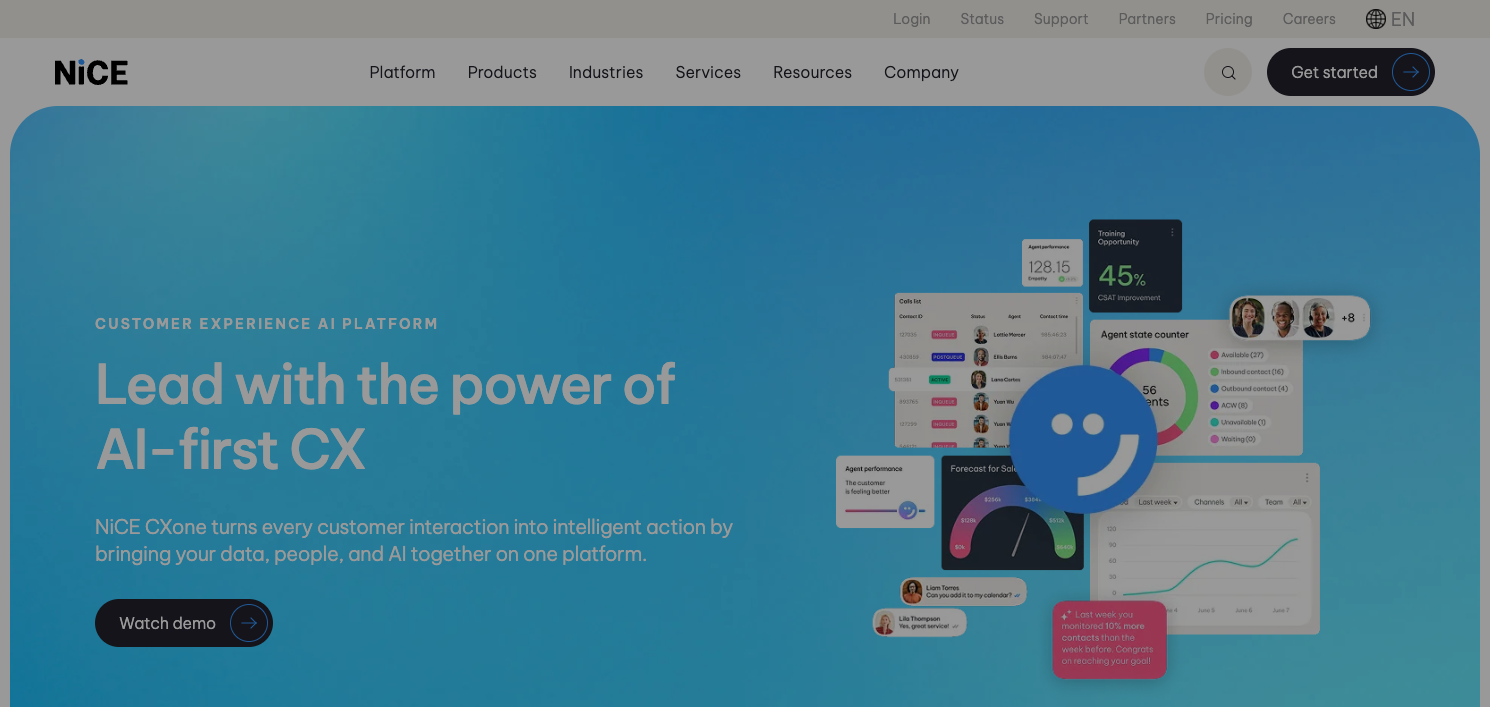
NICE CXone Mpower threads voice, digital and messaging channels into one agent view with Enlighten Copilot summarising the case in real time. The agent sees a continuous timeline across every channel the customer has used; the supervisor sees the same journey and Enlighten flags coaching moments without waiting for a QA analyst's review.
Estimate your NICE cost
Uses published $90.00/seat/mo starting rate. Updates as you type.
Estimator uses vendor-published list rates as anchor. Actual quotes vary by add-ons (AI, WFM, dialer minutes) — request a written quote before signing.
Book a NICE demo
Vendor-facilitated. We forward your request to their sales team within 24 hours.
- Choose a preferred date + time slot
- 30-minute product walkthrough
- Custom pricing based on your seat count
Screenshots

Pros
- Deepest WEM + QM bundle in the market
- Enlighten AI applied across CX, WEM and analytics
- Strong inbound omnichannel routing
Cons
- CXone licensing complex
- UI learning curve steeper than Talkdesk
- Implementation timelines often exceed initial estimates
Similar Contact Center Core Tools
User Reviews
Write a reviewNo reviews yet for NICE.
Be the first to review