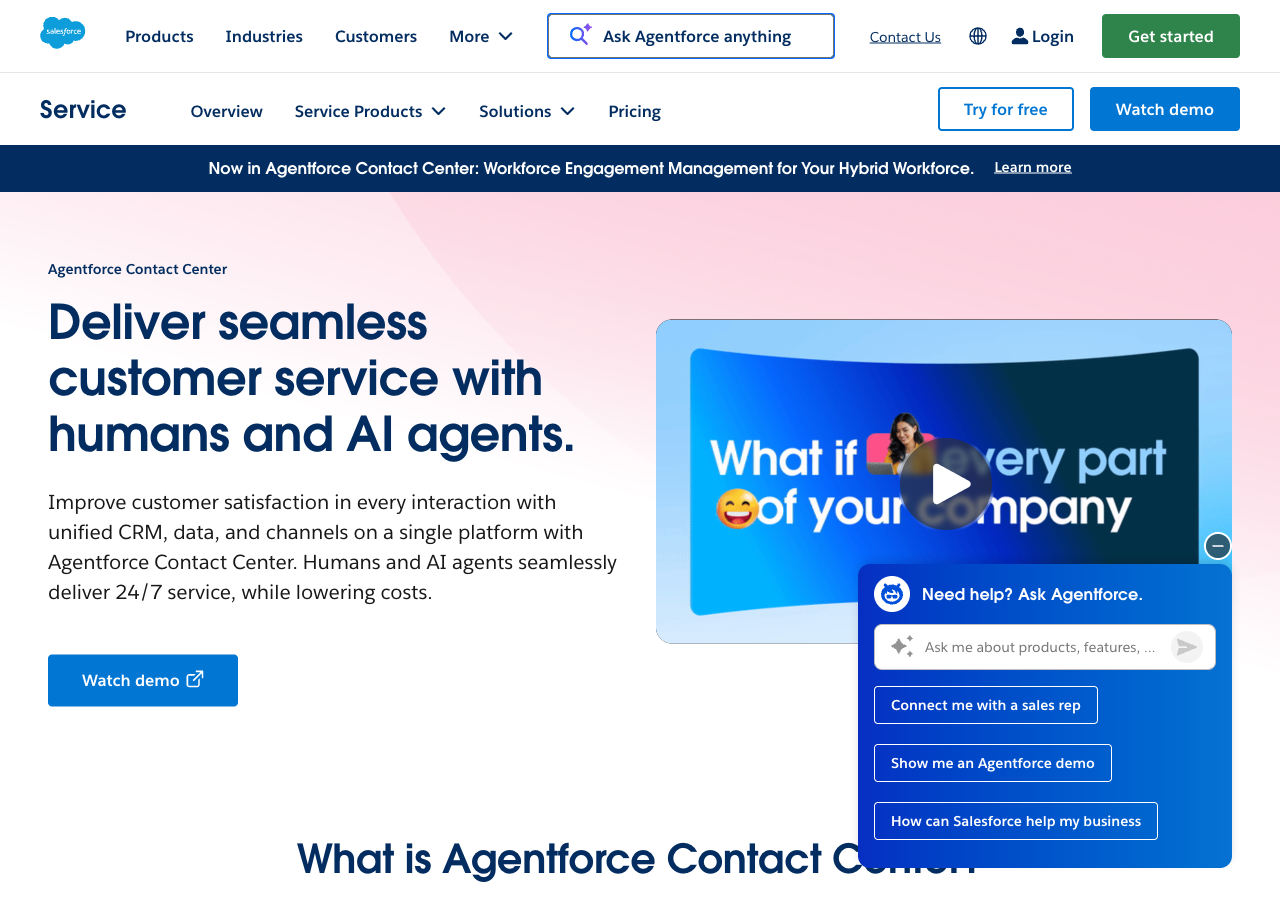
Salesforce rebranded Service Cloud as Agentforce Service at Dreamforce ‘25 in October 2025. Agentforce Contact Center was introduced in March 2026. Service Cloud Voice (SCV) was renamed to “Salesforce Voice with Telephony Providers” in current documentation. The product the catalog still calls Service Cloud has undergone three brand transitions across 6 months. Salesforce introduced “Flex Credits” in Q3 2025 as a new Agentforce consumption pricing model at $500 per 100,000 credits ($0.005 each), with standard actions costing 20 credits ($0.10) and voice actions costing 30 credits ($0.15). The Flex Credits model cannot coexist with the older $2-per-conversation model in the same Salesforce org. Salesforce was NOT named a Leader in the 2025 Gartner Magic Quadrant for CCaaS, despite a customer-service heritage longer than any pure-play CCaaS vendor.
This review covers what the Salesforce CCaaS product is in 2026 after the rebranding chain, how the Flex Credits and conversation-based consumption pricing works, where the federal-procurement posture sits (strongest in the field), and the documented limitations every Salesforce-anchored evaluation should weigh.
Company facts: Salesforce (NYSE: CRM), San Francisco
Salesforce trades on NYSE under ticker CRM. The company is headquartered in San Francisco. Service Cloud is Salesforce’s customer-service product, originally launched in 2009 and continuously rebuilt since. The current product naming after the October 2025 Dreamforce rebrand is “Agentforce Service,” with Agentforce Contact Center introduced as the specific CCaaS surface in March 2026.
The strategic context matters for your procurement. Salesforce + ServiceNow jointly invested $1.5 billion in Genesys in 2024. The investment signals that Salesforce is partnering with Genesys rather than building a standalone CCaaS to challenge NICE or Amazon Connect directly. The Service Cloud product extends CRM-native customer service workflows; the heavy-CCaaS-depth workflows route through Genesys partnership and the NICE Bring-Your-Own Contact Center integration in the Service Cloud unified desktop.
For your evaluation, the implication is structural. Salesforce Service Cloud is the deepest CRM-native customer service platform but NOT the deepest packaged CCaaS in the field. Buyers wanting CRM integration as the strategic anchor pick Service Cloud; buyers wanting standalone CCaaS depth pick the 2025 Gartner Leaders.
The rebranding chain: Service Cloud → Agentforce Service → Agentforce Contact Center
Three product-naming transitions during 2025-2026 affect your evaluation documentation.
| When | What changed | Catalog naming convention |
|---|---|---|
| October 2025 (Dreamforce ‘25) | Service Cloud rebranded as Agentforce Service | “Salesforce Service Cloud (now Agentforce Service)” |
| October 2025 | Service Cloud Voice (SCV) renamed “Salesforce Voice with Telephony Providers” | The voice telephony layer |
| March 2026 | Agentforce Contact Center introduced as specific CCaaS surface | New product line atop Agentforce Service |
For your procurement documentation, verify with your Salesforce account team which product naming applies to your specific contract. The rapid rebranding creates real confusion in RFPs and contract documents. The underlying product the catalog reviews is still what most buyers call “Salesforce Service Cloud,” but the current Salesforce-side naming has moved.
Pricing: Flex Credits, conversation model, all marketing pages 403
The Salesforce marketing and pricing pages returned HTTP 403 errors to automated fetch during research. The sales-led, anti-bot pricing posture is consistent with Salesforce’s commercial model: pricing requires sales engagement.
The published Flex Credits consumption model (Q3 2025 launch):
| Component | Rate | Notes |
|---|---|---|
| Flex Credits | $500 per 100,000 credits ($0.005 each) | New Agentforce consumption model |
| Standard action | 20 credits ($0.10) | E.g., agent assist intent classification |
| Voice action | 30 credits ($0.15) | Voice-specific Agentforce action |
| Conversation model | $2 per conversation | Older alternative pricing |
| Critical constraint | Flex Credits cannot coexist with the $2 conversation model in the same Salesforce org | Pick one model per org |
The “pick one model per org” constraint matters for procurement. If your Salesforce org already runs Agentforce on the conversation model, switching to Flex Credits requires org-wide commitment rather than per-team selection.
The new Agentforce 1 Edition bundles the Agentforce add-on with Flex Credits and Data Cloud as a single SKU. The bundling simplifies procurement for buyers committing to the full Agentforce surface.
Beyond Flex Credits and the Agentforce 1 Edition, Service Cloud Voice / Salesforce Voice with Telephony Providers carries per-seat licensing on top of base Service Cloud. The per-seat rates require sales engagement and are not surfaced publicly.
NICE Bring-Your-Own Contact Center: the 2025-26 partnership
The strategic 2025-2026 development worth flagging: Salesforce shipped a NICE Bring-Your-Own Contact Center integration that adds NICE CXone into the Service Cloud unified desktop. The partnership lets Salesforce-anchored buyers route contact center workflows through NICE CXone (a 2025 CCaaS Leader with $328M FY2025 AI ARR +66%) without leaving the Salesforce-native UI.
The partnership matters strategically. Salesforce is not building Service Cloud Voice / Salesforce Voice into a NICE or Genesys competitor. Salesforce is partnering with the CCaaS Leaders to extend Service Cloud workflows. The BYO Contact Center integration signals that Salesforce wants the CRM-native UI plus the dedicated CCaaS engine, not the all-in-one bundle.
For your evaluation, this means a Salesforce-anchored CCaaS deployment can use Service Cloud as the system of record while routing voice and contact-center-specific workflows through NICE CXone underneath. The architecture is more complex than a pure Salesforce or pure NICE deployment, but the combination is now a vendor-supported pattern rather than a custom integration.
Federal posture: strongest in the field
Salesforce Government Cloud Plus holds FedRAMP High plus DoD IL4 authorization. The combination is the strongest federal cloud posture in the contact center as a service catalog.
For comparison:
- Salesforce Government Cloud Plus: FedRAMP High + DoD IL4
- AWS Amazon Connect (Government cloud regions): FedRAMP High
- NICE CXone: FedRAMP Moderate
- Genesys Cloud CX: FedRAMP
- Five9: GovRAMP membership, TexasRAMP Level 2 (no FedRAMP)
- Twilio Flex: NO FedRAMP
- RingCX: No public FedRAMP badge
If your evaluation is federal-procurement-led at the highest impact level, Salesforce Government Cloud Plus is structurally easier to procure than every other catalog vendor. The DoD IL4 authorization specifically extends to Department of Defense workflows that the broader FedRAMP High alone does not cover.
2025 Gartner positioning: NOT a CCaaS Leader
The September 8, 2025 Gartner CCaaS Magic Quadrant did NOT place Salesforce Service Cloud (or its Agentforce Service rebrand) in the Leaders quadrant. The 5 Leaders are NICE, Genesys, Five9, Talkdesk, and AWS Amazon Connect.
The absence is structural rather than a placement drop. Salesforce competes in customer service software broadly and in CRM-native contact center workflows specifically. Gartner’s CCaaS MQ targets pure-play CCaaS evaluations where the platform’s identity is contact center rather than CRM with contact center extensions. The Salesforce + ServiceNow $1.5B investment in Genesys reinforces the positioning: Salesforce is the CRM, Genesys is the CCaaS, and the strategic alignment between them is the architecture.
For procurement evaluations weighting CCaaS Magic Quadrant Leader placement specifically, Salesforce Service Cloud does not qualify. For procurement evaluations weighting CRM-native customer service workflows, Salesforce remains the deepest option in the catalog.
Channel coverage and Einstein / Agentforce AI
Salesforce Service Cloud covers email, web chat, SMS, WhatsApp Business API, social messaging, and (through Service Cloud Voice / Salesforce Voice with Telephony Providers) inbound and outbound voice. The channel breadth covers the standard CCaaS surface, though voice depth depends on the telephony partner relationship (AWS Amazon Connect inheritance, Vonage Contact Center, or other partners through the Salesforce Voice with Telephony Providers framework).
Einstein Copilot for Service (now branded as part of Agentforce Service) brings generative agent assist, case summarization, and intent capture to the Service Cloud workspace. The product draws on the case and knowledge data already in Salesforce, giving it integration depth competitors building from outside cannot match.
Agentforce Service positions for autonomous customer interaction handling that goes past agent assist into containment. The vendor frames “85% autonomous resolution” as the marketing target; verify the specific feature GA status and customer-reference deployment metrics with your Salesforce account team rather than asserting the figure as production reality.
Where Salesforce Service Cloud still falls short
A vendor-neutral review names the gaps. Salesforce Service Cloud has four documented limitations that should sit in your evaluation matrix.
Not a 2025 Gartner CCaaS Magic Quadrant Leader. The Magic Quadrant absence is structural rather than a placement movement. Procurement evaluations weighting CCaaS-specific Leader placement should know the distinction.
Rebranding chain creates documentation confusion. Service Cloud → Agentforce Service → Agentforce Contact Center across 6 months affects RFP documentation, contract naming, and internal communications. Verify the current Salesforce-side naming for your specific quote.
All marketing pages returned 403 to automated fetch. The sales-led pricing posture means buyers cannot model cost from public information. Service Cloud Voice / Salesforce Voice with Telephony Providers per-user rates are not publicly published.
Pricing complexity from Flex Credits versus conversation model. The two consumption models cannot coexist in the same Salesforce org. Picking the wrong model creates org-wide migration cost. Model the consumption math against your projected workflow before signing.
How Salesforce Service Cloud compares with the 2025 Leaders
Salesforce Service Cloud vs Genesys Cloud CX. Genesys is a 2025 CCaaS Leader; Service Cloud is not. Salesforce + ServiceNow invested $1.5B in Genesys 2024 — the strategic signal that Salesforce is partnering with Genesys rather than competing. Both products coexist in the same enterprise stack typically.
Salesforce Service Cloud vs NICE CXone. NICE is a 2025 CCaaS Leader. Salesforce shipped NICE Bring-Your-Own Contact Center integration into Service Cloud unified desktop during 2025-26. The two products are increasingly aligned via partnership rather than direct competition.
Salesforce Service Cloud vs AWS Amazon Connect. Both hold strong federal posture (Salesforce Gov Cloud Plus FedRAMP High + DoD IL4, AWS FedRAMP High). Amazon Connect is per-minute consumption; Service Cloud is per-seat plus Flex Credits. Engineering teams pick Amazon Connect; CRM teams pick Service Cloud.
Salesforce Service Cloud vs Vonage Contact Center. Vonage is the deepest third-party Salesforce-native CCaaS option (4.93/5 across 1,000+ AppExchange reviews). Service Cloud Voice is the Salesforce-direct option. Vonage for budget-sensitive Salesforce buyers; Service Cloud Voice for Salesforce-anchored direct-vendor preference.
The bottom line for a Salesforce-anchored evaluator
Salesforce Service Cloud is the structural pick when Salesforce is the system of record, when CRM-native customer service workflows drive the buying decision, and when FedRAMP High plus DoD IL4 federal posture is required at the highest impact level. The Einstein / Agentforce AI integration draws on case and knowledge data Salesforce already holds. The NICE Bring-Your-Own Contact Center partnership extends to NICE CXone capabilities without leaving the Salesforce UI.
The cost is the 2025 CCaaS Magic Quadrant non-Leader placement, the rebranding chain creating documentation confusion, the sales-gated pricing limiting public modeling, and the Flex Credits versus conversation model org-wide pricing constraint.
For Salesforce-anchored enterprise customer service operations where CRM is non-negotiable, Service Cloud belongs at the top of the shortlist. For non-Salesforce evaluations or pure CCaaS feature-depth evaluations, the 2025 CCaaS Leaders (NICE, Genesys, Five9, Talkdesk, Amazon Connect) fit better.
Verify the current Salesforce-side naming for your contract, the Flex Credits versus conversation model decision for your org, Service Cloud Voice telephony partner selection, and FedRAMP impact level scope directly with your Salesforce account team. The Government Cloud Plus authorization is firm; commercial pricing requires negotiation.
Methodology
This review draws from Salesforce official documentation surfaces (most marketing pages returned 403 to automated fetch during research), the October 2025 Dreamforce ‘25 rebrand announcements, the March 2026 Agentforce Contact Center launch documentation, the Q3 2025 Flex Credits introduction, the NICE Bring-Your-Own Contact Center partnership announcements, Salesforce Trust documentation for FedRAMP scope.
Verification process: the rebranding chain was verified across multiple Salesforce press releases. Flex Credits pricing and the cannot-coexist-with-conversation-model constraint came from public Agentforce documentation. FedRAMP High plus DoD IL4 was verified against the FedRAMP marketplace.
For category context, see What is CCaaS and Cloud Contact Center. For 2025 Gartner CCaaS Leaders, see NICE, Genesys, Five9, Talkdesk, and Amazon Connect. For the Salesforce-native alternative third-party CCaaS, see Vonage Contact Center.
What each role sees on Salesforce Service Cloud Voice
- Agent — handles voice, email, chat, messaging and case work inside the Salesforce Service Cloud console with Einstein Copilot suggesting next-best actions and every interaction attached to the Salesforce Case record.
- Supervisor — watches live queues, service level and agent state in the Service Cloud Voice Omni-Channel Supervisor view, coaches through whisper, and reassigns cases across skills without leaving Salesforce.
- QA analyst — reviews Contact Center Analytics transcripts and Einstein Conversation Insights scores, evaluates agents against configurable scorecards, and attaches coaching to the specific case.
- WFM manager — forecasts case volume and publishes agent schedules in Salesforce Workforce Engagement, tracks adherence, and reruns forecasts as case volume arrives.
- IT / telecom admin — connects via Amazon Connect (default) or partner telephony (Genesys, Vonage, Cisco Webex CC), enforces SSO through Salesforce Identity or SAML IdPs, and runs on Salesforce Government Cloud Plus with FedRAMP High and DoD IL4 authorization.
Unified agent desktop and cross-channel history
Because voice, email, chat and messaging all route into the same Salesforce Case, the agent sees one continuous customer history without leaving the Service Cloud console they already know. Channel switches keep the case number and the Einstein-generated summary intact; the supervisor sees the same case timeline and can route it to a specialist queue with one click.
Estimate your Salesforce Service Cloud cost
Uses published $165.00/seat/mo starting rate. Updates as you type.
Estimator uses vendor-published list rates as anchor. Actual quotes vary by add-ons (AI, WFM, dialer minutes) — request a written quote before signing.
Book a Salesforce Service Cloud demo
Vendor-facilitated. We forward your request to their sales team within 24 hours.
- Choose a preferred date + time slot
- 30-minute product walkthrough
- Custom pricing based on your seat count
Screenshots
Pros
- CRM-native — every interaction lands on the customer record
- Einstein AI across cases, knowledge and conversation
- Massive AppExchange ecosystem
Cons
- Voice channel via Service Cloud Voice — extra licence
- Reporting requires Salesforce CRM Analytics for depth
- Total cost can exceed standalone CCaaS plus CRM
Similar Contact Center Core Tools
User Reviews
Write a reviewNo reviews yet for Salesforce Service Cloud.
Be the first to review