
Dialpad founder Craig Walker built GrandCentral. Google acquired GrandCentral in 2007 and rebranded the product as Google Voice. The same engineering team built Dialpad starting in 2011 around a proprietary speech recognition stack trained on millions of business calls. The AI-first DNA at Dialpad is not marketing positioning; it is literally ex-Google Voice. The 2025 Gartner Magic Quadrant for CCaaS placed Dialpad as an Honorable Mention, with parallel Visionary placement on the UCaaS MQ. Buyers expecting Dialpad to appear in the CCaaS Leaders quadrant will misread the analyst placement.
This review covers what Dialpad is in 2026, what the company actually publishes about pricing (which is less than buyers expect), how the per-minute surcharges layer on top of seat fees, the UCaaS plus CCaaS unified-agent-experience claim, and the documented limitations every mid-market evaluation should weigh.
Company facts: private, San Francisco, founded 2011
Dialpad is a private company headquartered in San Francisco. The company was founded in 2011 by Craig Walker, Brian Peterson, and John Rector. Walker’s earlier company GrandCentral was acquired by Google in 2007 and rebranded as Google Voice. The Dialpad team carries the same lineage that built the original Google Voice platform.
The strategic differentiator is the proprietary speech recognition engine, originally branded TalkIQ. Most competitors build AI features on third-party speech-to-text vendors (Deepgram, Google Speech, AWS Transcribe). Dialpad operates its own stack, with model updates and accuracy improvements shipping continuously rather than through partner API roadmaps.
Dialpad does not publish revenue, customer count, or specific employee figures on a recurring basis. The last reported valuation came from a 2023 funding round; subsequent valuation refreshes have not surfaced publicly. Verify the current company state directly with your account team rather than asserting figures from third-party aggregators.
Pricing: official pages returned 403 during deep crawl
The Dialpad official pricing pages returned HTTP 403 errors to automated fetch during research. The anti-bot posture is consistent with sales-led commercial vendors but limits public modeling.
Cross-source consensus from 2026 third-party breakdowns places the Ai Contact Center tier ladder around $80 / $115 / $150 per seat per month. Treat these as planning estimates rather than firm quotes.
| Tier | Per seat /mo | Notes |
|---|---|---|
| Ai Contact Center Standard | ~$80 | Voice + chat entry tier |
| Ai Contact Center Pro | ~$115 | + Outbound campaigns, deeper analytics |
| Ai Contact Center Enterprise | ~$150 | + Advanced AI, supervisor surfaces |
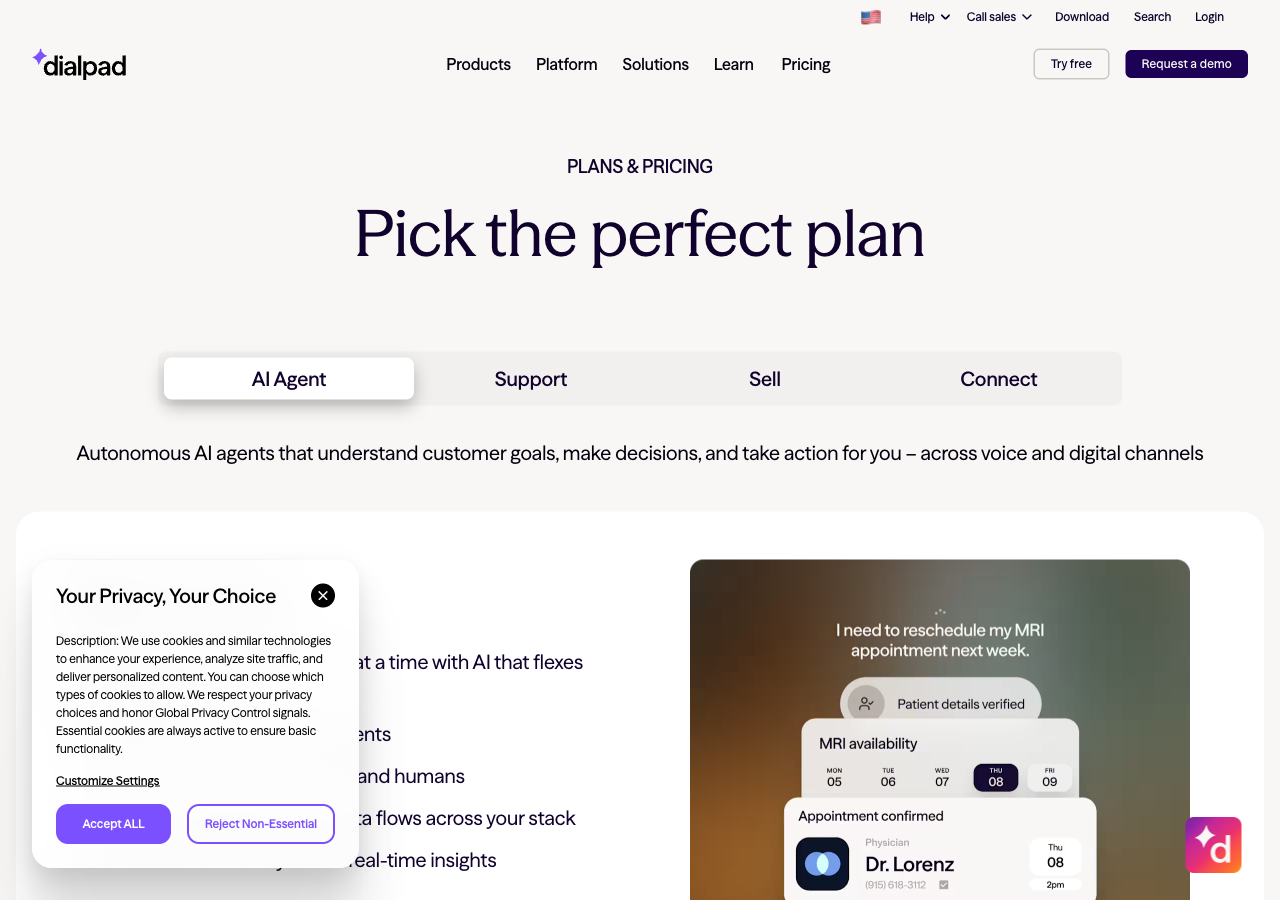
| Dialpad AI Agents | Quote-only | Agentic AI add-on |
Verify the current tier names and prices directly on the Dialpad site (or with your account team) before quoting internally. The official pages do not respond to automated fetches, and tier composition shifts quarterly across the category.
Per-minute surcharges layer on top of seat fees
The structural pricing detail that buyers regularly miss: Dialpad layers per-minute surcharges on top of seat licensing for the Support and Sell SKUs in particular. Third-party verified rates run approximately $0.01 per inbound minute and $0.02 per outbound minute on top of the seat fee.
For a 100-seat operation projecting 50 voice minutes per agent per day, 250 working days per year: 1.25 million inbound minutes plus 1.25 million outbound minutes annually. At the surcharge rates that is $12,500 inbound plus $25,000 outbound, or $37,500/year on top of the seat licensing. The $80 to $150 sticker per seat per month understates the real cost by a meaningful margin.
International calling switches to metered rates after a prepaid bundle of approximately 1,500 Calling Credit minutes per month. International rates vary by country and should be requested as a per-country price sheet during evaluation if your operation handles international voice volume.
Three CCaaS SKUs: Connect, Support, Sell
Dialpad ships three distinct CCaaS SKUs targeting different operating use cases.
Dialpad Connect is the general-purpose CCaaS with inbound voice, basic outbound, and digital channels. The tier is the closest analog to traditional CCaaS suites and competes against RingCX, Five9 Core, and Talkdesk Voice Essentials.
Dialpad Support targets customer service teams with case-management workflows, knowledge base integration, and AI agent assist optimized for support interactions. The SKU competes against Zendesk Talk and Salesforce Service Cloud Voice.
Dialpad Sell targets sales teams with CRM-integrated outbound dialing, call-coaching surfaces, and Sales-Engagement-Platform-style outreach automation. The SKU competes against Five9 outbound and dedicated outbound platforms like Outreach or Salesloft.
The three-SKU model gives Dialpad sharper positioning per use case than competitors selling a single unified CCaaS. The downside is fragmentation: a blended team that does both support and sales may need both SKUs, doubling licensing costs. Verify which SKU fits your specific workflow during evaluation.
Dialpad Ai: proprietary speech engine and agentic features
Dialpad’s AI brand is Dialpad Ai. The product surface includes real-time transcription on every call, AI Recap (auto-generated wrap-up notes), live agent assist with knowledge surfacing, sentiment scoring during interactions, and Ai Scripts (suggested next-best-action prompts).
The proprietary speech engine is the strategic differentiator. Third-party speech-to-text vendors require model swaps to improve accuracy on noisy phone audio. Dialpad operates its own model, training continuously on the business-call corpus the platform processes. The accuracy advantage is most pronounced on long-tail vocabulary (industry jargon, brand names, account identifiers) where third-party generic models underperform.
Dialpad Ai Agents is the agentic AI surface for autonomous customer interaction handling. Pricing is quote-only. Verify GA status and feature scope with your account team during evaluation rather than asserting capabilities from marketing materials.
2025 Gartner positioning: Honorable Mention, not Leader
The September 8, 2025 Gartner Magic Quadrant for CCaaS placed Dialpad as an Honorable Mention, not in the Leaders, Visionaries, Challengers, or Niche Players quadrants. The parallel 2025 UCaaS Magic Quadrant placed Dialpad as a Visionary.
This matters for procurement evaluations that weight analyst recognition. The 5 CCaaS Leaders in 2025 are NICE, Genesys, Five9, Talkdesk, and AWS Amazon Connect. Cisco Webex Contact Center sits as Niche Player. 8x8 sits as Honorable Mention. Buyers should not call Dialpad a CCaaS Leader, Visionary, or Challenger; the placement is Honorable Mention on the CCaaS MQ.
The UCaaS Visionary placement is the stronger analyst signal for buyers evaluating Dialpad on UCaaS-plus-CCaaS bundle merits rather than pure CCaaS depth.
UCaaS plus CCaaS: the genuinely unified bundle
Dialpad’s structural advantage over RingCentral, 8x8, Vonage, and Nextiva is bundle integration depth. RingCX is licensed separately from RingEX (two seat licenses for one contact center agent). 8x8 markets XCaaS as a single platform but the underlying agent surface still differs by SKU. Dialpad sells a more genuinely unified agent experience: one app, one identity, one admin surface.
The unified bundle matters for blended operations where the same person handles internal team communications and external customer interactions through one product. A 50-seat team with a sales floor and a support function can run on Dialpad without seat-license double-billing.
For pure CCaaS evaluations where UCaaS is handled by Microsoft Teams or a separate Zoom Phone deployment, the bundle advantage disappears. Compare Dialpad against Talkdesk, Five9, or RingCX on standalone CCaaS merits.
Compliance and federal posture
Dialpad holds SOC 2 Type II, ISO 27001, HIPAA-BAA, GDPR, and PCI DSS coverage for standard contact center workflows. The Trust Center documents the certifications.
FedRAMP authorization tier is open research as of June 2026. Dialpad has not publicly listed FedRAMP authorization on its Trust Center. Federal-procurement-led buyers should verify the current status directly with the Dialpad account team. For federal-procurement-led evaluations, NICE (FedRAMP Moderate), Genesys (FedRAMP), AWS Amazon Connect (FedRAMP via AWS), or Salesforce Government Cloud Plus (FedRAMP High plus DoD IL4) are structurally easier paths.
Where Dialpad still falls short
A vendor-neutral review names the gaps. Dialpad has four documented limitations that should sit in your evaluation matrix.
Pricing pages do not respond to automated fetch. The 403 response on the official pricing page limits public modeling. Third-party breakdowns put tier pricing in the $80 to $150 range, but you cannot verify directly from the vendor site without sales engagement.
Per-minute surcharges hidden in the seat sticker. The $0.01 inbound and $0.02 outbound per-minute fees layer on top of the seat fee and add meaningful TCO. Build the 3-year cost projection with explicit minute math against your projected voice volume.
Honorable Mention on the 2025 Gartner CCaaS MQ. Procurement evaluations weighting analyst placement should know that Dialpad is not a Leader, Visionary, or Challenger on the CCaaS quadrant. The UCaaS Visionary placement is the relevant analyst signal for bundle evaluations.
Enterprise WEM is not the story. The platform optimizes for SMB and lower mid-market AI-first deployments. Enterprise WFM, dedicated quality functions, and large-scale supervisor consoles trail NICE CXone, Genesys Cloud CX, and Talkdesk. Very large deployments (2,000-plus seats) report scaling limitations in supervisor tooling.
How Dialpad compares with the other vendors
Dialpad vs RingCentral RingCX. Dialpad ships a more genuinely unified UCaaS plus CCaaS agent experience. RingCX requires two seat licenses for unified UCaaS-plus-CCaaS coverage. RingCX publishes $65 / $95 / $145 transparent pricing; Dialpad pages 403 to automated fetch. RingCX bundles AI at Professional $95; Dialpad layers per-minute surcharges.
Dialpad vs Five9. Five9 leads on outbound dialer DNA, TCPA compliance tooling, and disclosed AI ARR ($100M, +50% YoY). Dialpad leads on UCaaS-plus-CCaaS unification and proprietary speech engine. Five9 50-seat minimum excludes SMB; Dialpad fits SMB and lower mid-market.
Dialpad vs Aircall. Both target SMB and lower mid-market. Aircall publishes $30 Essentials pricing with no AI focus. Dialpad starts higher (~$80) with AI as the wedge. Aircall ships in days; Dialpad takes longer to deploy. SMB voice-first teams favor Aircall; AI-first teams favor Dialpad.
Dialpad vs Talkdesk. Talkdesk is a 2025 Gartner Leader; Dialpad is Honorable Mention. Talkdesk requires 3-year minimum; Dialpad commercial terms are shorter. Talkdesk publishes Industry Experience Clouds; Dialpad bundles UCaaS plus CCaaS.
The bottom line for an AI-first mid-market evaluator
Dialpad is the structural pick when AI is the strategic wedge and you want the proprietary speech engine rather than third-party model dependencies. The ex-Google Voice lineage is the engineering pedigree. The UCaaS plus CCaaS unification is genuinely deeper than the bundle marketing from RingCentral, 8x8, Vonage, or Nextiva. The Dialpad Ai surface area (transcription, agent assist, sentiment, AI Recap, Ai Scripts) competes credibly against NICE Enlighten and Talkdesk Copilot for AI maturity.
The cost is opaque pricing pages, per-minute surcharges hidden in the seat sticker, Honorable Mention rather than Leader analyst placement, and enterprise WEM that trails the 2025 Leaders.
For SMB and mid-market operations evaluating AI-first CCaaS where UCaaS plus CCaaS unification matters, Dialpad belongs on the shortlist. For enterprise WEM-led, federal-procurement-led, or analyst-recognition-led evaluations, NICE, Genesys, or AWS Amazon Connect fits better.
Verify current pricing, per-minute surcharge rates, and AI Agents commercial terms directly with your Dialpad account team. The published tier ranges are planning estimates; actual quotes require sales engagement.
Methodology
This review draws from third-party 2026 pricing breakdowns (CloudTalk, Nextiva blog, Platform28, Capterra), the September 2025 Gartner Magic Quadrant for CCaaS placement summary, the parallel UCaaS Magic Quadrant placement, the Dialpad Trust Center compliance page.
Verification process: pricing claims came from cross-source third-party breakdowns because the Dialpad official pricing page returned HTTP 403 to automated fetch. Compliance posture was verified against the Dialpad Trust Center where accessible.
For category context, see What is CCaaS and Cloud Contact Center. For head-to-head comparison, see Dialpad vs Aircall. For 2025 Gartner Leaders, see NICE, Genesys, Five9, Talkdesk, and Amazon Connect.
What each role sees on Dialpad
- Agent — handles voice, video, SMS and messaging in the unified Dialpad Ai Contact Center desktop with Dialpad Ai transcribing the conversation live and pulling context from Salesforce, HubSpot or Zendesk.
- Supervisor — watches live sentiment, call reason and queue metrics in the Dialpad Ai Coaching Hub, listens in on any call, and jumps in with whisper or barge when Dialpad Ai flags a struggling interaction.
- QA analyst — auto-scores every call with Dialpad Ai QA Scorecards, reviews sentiment and objection-handling trends, and attaches coaching notes to the specific transcript segment.
- WFM manager — forecasts inbound volume and builds agent schedules in Dialpad Wfm, tracks adherence, and adjusts staffing against real-time actuals.
- IT / telecom admin — provisions numbers in 70+ countries from the Dialpad admin, enforces SSO through Okta, Google Workspace or Microsoft Entra ID, and runs the platform against Dialpad's five-nines SLA.
Unified agent desktop and cross-channel history
Dialpad's contact center runs on the same platform as its business phone and messaging products, so an agent moves a customer from chat to voice to video without a handoff. Dialpad Ai transcribes and summarises every channel in one thread; the supervisor sees the same unified conversation and can pull a subject-matter expert into a live call in one click.
Estimate your Dialpad cost
Uses published $80.00/seat/mo (third-party est) starting rate. Updates as you type.
Estimator uses vendor-published list rates as anchor. Actual quotes vary by add-ons (AI, WFM, dialer minutes) — request a written quote before signing.
Book a Dialpad demo
Vendor-facilitated. We forward your request to their sales team within 24 hours.
- Choose a preferred date + time slot
- 30-minute product walkthrough
- Custom pricing based on your seat count
Screenshots
Pros
- Real-time transcription and AI Recap on every call
- Modern UI and fast deployment
- Tight UCaaS + CCaaS bundle
Cons
- Outbound dialer less mature than Five9
- Enterprise omnichannel still maturing
- PSTN footprint smaller than RingCentral/Vonage
Similar Contact Center Core Tools
User Reviews
Write a reviewNo reviews yet for Dialpad.
Be the first to review