
Aircall publishes Essentials at $30 per seat per month on its official pricing page. The figure is the cleanest entry-tier price among the 15 vendors in this catalog. The structural detail that catches buyers off-guard: Aircall bills per license rather than per active user. If you provision 50 seats and only use 35, you pay for 50. The pricing model is the inverse of Five9’s per-concurrent-user approach, where the same 50-agent operation running 35 concurrent shifts would pay for 35 seats. Aircall did not appear in the September 8, 2025 Gartner Magic Quadrant for CCaaS, which is consistent with its SMB voice-first positioning rather than an enterprise contact center pitch.
This review covers what Aircall is in 2026, how the published pricing actually works once add-ons and SSO gating are factored in, where the PCI DSS and FedRAMP claims come from (AWS, not Aircall directly), and the documented limitations every SMB or lower mid-market evaluation should weigh.
Company facts: private, Paris and New York, founded 2014
Aircall is a private company with headquarters in Paris and New York. The company was founded in 2014 with an explicit SMB voice-first product focus and 100-plus integrations with the CRMs and helpdesks SMBs actually use (HubSpot, Salesforce, Zendesk, Intercom, Pipedrive, Front, and more).
The product is intentionally narrower than Tier 1 enterprise CCaaS platforms. Voice-first means inbound and outbound voice plus SMS, with digital channels handled through integrations rather than native multichannel routing. The focus is what makes Aircall ship in days rather than weeks.
Aircall does not disclose revenue, customer count, or specific employee figures on a recurring basis. The last reported funding round and valuation were earlier than the 2026 evaluation date, and verifying current company state requires direct sales engagement.
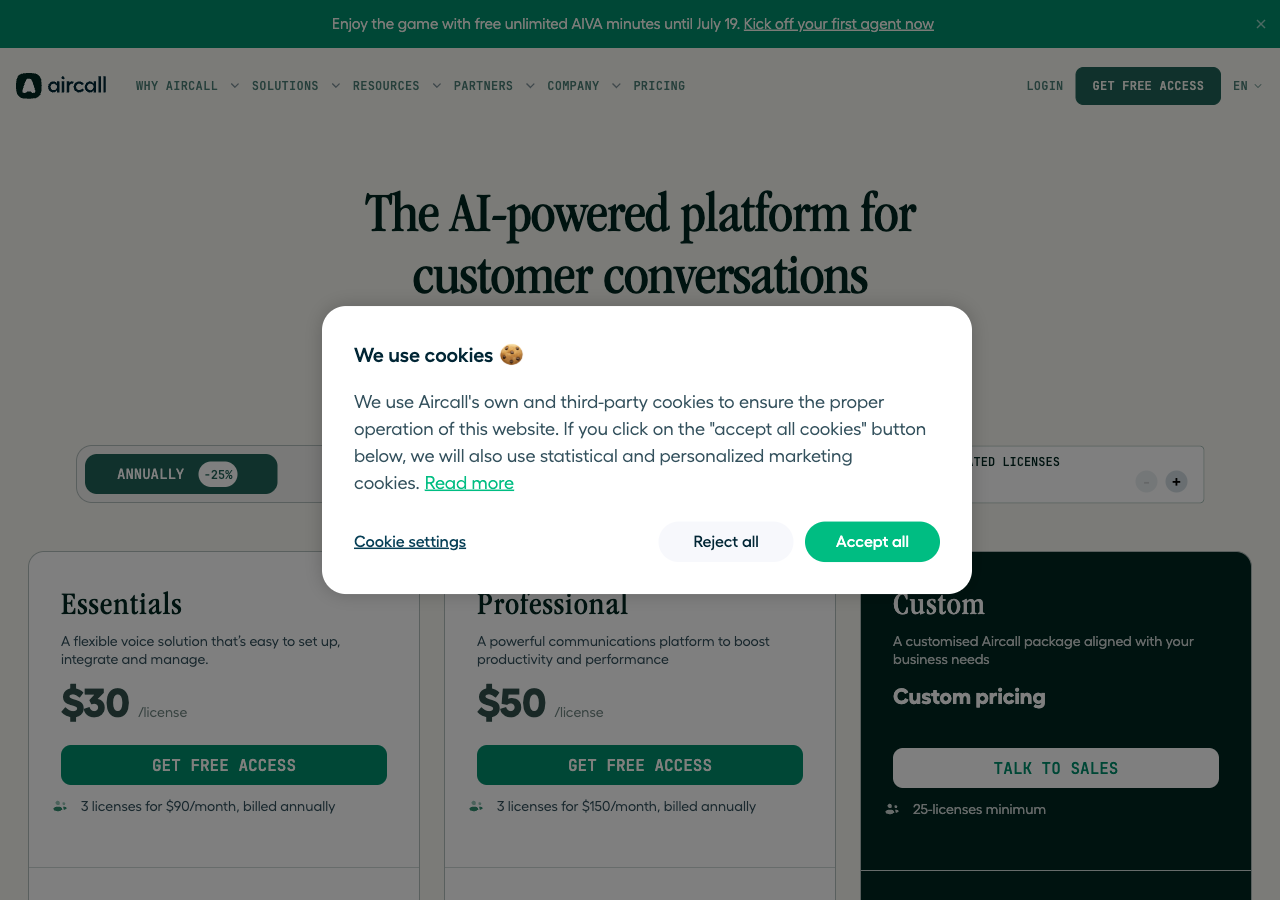
Pricing: Essentials $30 published, per-license billing model
Aircall publishes three pricing tiers on the official pricing page. The transparency is meaningful: among the 15 vendors in the catalog, only Aircall, RingCentral, Five9, Talkdesk, and Amazon Connect publish full per-seat or per-minute pricing for the majority of their tier ladder.
| Tier | Per seat /mo | Notes |
|---|---|---|
| Essentials | $30 | Voice, SMS, basic integrations |
| Professional | $50 | + Advanced analytics, deeper integrations |
| Custom | Sales-gated | + SSO, dedicated CSM, 25-seat minimum |
The $30 Essentials tier is the cleanest entry price in the catalog. Five9’s published entry is $119 Digital. RingCX starts at $65 Standard. Talkdesk starts at $85 Digital Essentials. Dialpad starts around $80. For SMB operations evaluating voice-first CCaaS at sub-50 seats, Aircall’s $30 sticker is structurally lower than every Tier 1 competitor.
Per-license, not per-active-user. This is the structural billing distinction. If you provision 50 Aircall seats but only 35 agents log in regularly, you pay for 50. The model favors steady-state operations with high seat utilization and disfavors operations with variable utilization or rotating shift patterns. Compare against Five9’s per-concurrent-user model (the inverse) before committing.
AI Voice Agent: launched April 2025, 50 free minutes per month
Aircall launched its AI Voice Agent on April 15, 2025. The product is positioned for after-hours coverage, overflow containment, and intent capture rather than autonomous full-resolution agentic AI.
The notable detail: the AI Voice Agent ships with 50 free minutes per month per account, even on the $30 Essentials tier. The free allocation materially extends what a small operations team can cover without staffing additional agents. For an SMB operation receiving 200 inbound calls per month, allocating 50 to AI Voice Agent absorption shrinks the active-agent workload by 25%.
Above the 50 free minutes, AI Voice Agent consumption is metered. Verify the per-minute rate with your account team during evaluation; the overage rate is not consistently surfaced in public documentation.
For SMB and lower mid-market operations where AI is a wedge but not the primary buying criterion, the Aircall AI Voice Agent is a credible bundled add-on. For AI-first evaluations, Dialpad’s proprietary speech engine or Talkdesk’s Copilot/Autopilot agentic AI fit better.
Compliance: PCI DSS and FedRAMP claims are AWS inheritance, not Aircall’s own
The compliance claim that catches buyers off-guard: the PCI DSS and FedRAMP credentials on Aircall’s security page are framed as AWS host-provider inheritance rather than Aircall’s own direct certifications.
For your evaluation, the distinction is critical. AWS holds PCI DSS and FedRAMP certifications because AWS holds them at the infrastructure layer. Applications running on AWS inherit some of the underlying credentials but the application provider (Aircall in this case) must implement and certify the application-layer controls independently for many compliance scenarios.
If your evaluation requires the contact center vendor itself to hold PCI DSS certification for cardholder data workflows or FedRAMP authorization for federal procurement, Aircall’s inheritance does not satisfy the requirement. Verify with the Aircall account team whether the specific compliance scope you need is covered by application-layer controls or only by AWS infrastructure-layer credentials.
SSO gated to the 25-seat Custom tier
Single Sign-On (SSO) integration with Okta, Microsoft Entra ID, Google Workspace, or other identity providers is gated to the Custom tier on Aircall, which requires a minimum of approximately 25 seats and sales-engagement pricing.
The SSO gating is a structural mid-market gap. Mid-market operations with security policies requiring SSO for all SaaS access cannot deploy Aircall on the published Essentials or Professional tiers; they must enter the sales-gated Custom tier even at 10 to 20 seats. Compare against RingCX, where SSO is bundled across all paid tiers including Standard $65.
For SMB operations under 25 seats without strict SSO security requirements, the gating is not a blocker. For mid-market operations with security-first procurement, plan to enter the Custom tier from the start.
250-plus marketplace integrations
Aircall’s marketplace lists more than 250 integrations across CRM, helpdesk, productivity, and AI overlay categories. The breadth is among the highest at the SMB price tier in the catalog.
CRM coverage includes HubSpot, Salesforce, Zoho CRM, Pipedrive, and SugarCRM. Helpdesk and ticketing covers Zendesk, Intercom, Front, Help Scout, and Freshdesk. Productivity supports Slack, Microsoft Teams, and Google Workspace. The integration breadth is one of the structural arguments for Aircall over a thinner platform like Nextiva (32 listed integrations).
Verify the specific connector your operation depends on by name during evaluation. The marketplace count is broad but individual connector depth varies.
2025 Gartner positioning: not in the CCaaS MQ
Aircall did not appear in the 2025 Gartner Magic Quadrant for CCaaS. The absence is consistent with the SMB voice-first product positioning. Gartner’s CCaaS MQ targets enterprise contact center evaluations at scale; Aircall’s typical deployment size falls below the enterprise threshold the MQ surveys.
For procurement evaluations weighting analyst placement, Aircall’s MQ absence matters for buyers comparing against the 2025 Leaders (NICE, Genesys, Five9, Talkdesk, AWS Amazon Connect). For SMB voice-first evaluations where the MQ Leaders are structurally over-built, the absence is not a blocker.
Channel coverage and product portfolio
Aircall is voice-first with SMS, web chat through integrations, and digital channels routed through CRM and helpdesk connectors rather than native multichannel routing. The product does not pretend to compete with Talkdesk or Genesys on omnichannel depth; the positioning is voice plus SMS plus integration-routed digital.
The product surface in 2026 spans Aircall (the core voice CCaaS platform), AI Voice Agent (launched April 2025), the marketplace of 250+ integrations, and the standard SMB-friendly admin and reporting surfaces.
Where Aircall still falls short
A vendor-neutral review names the gaps. Aircall has four documented limitations that should sit in your evaluation matrix.
Per-license billing, not per-active-user. Operations with variable utilization or rotating shift patterns pay for seats that go unused. Five9’s per-concurrent-user model is the inverse, and shift-based operations often model materially lower cost on Five9 despite the higher sticker.
SSO gated to 25-seat Custom tier. Mid-market operations with SSO security requirements must enter sales-gated pricing even at 10 to 20 seats. The gating is a structural mid-market gap.
PCI DSS and FedRAMP are AWS inheritance, not Aircall’s own. Compliance evaluations requiring application-layer vendor certifications may not be satisfied by infrastructure-layer AWS credentials. Verify scope with the Aircall account team.
Not in the 2025 Gartner CCaaS MQ. SMB voice positioning is structurally outside the MQ’s enterprise CCaaS scope. For procurement evaluations weighting analyst placement, the absence matters.
Anything past 100 seats outgrows Aircall quickly. The WEM and analytics surfaces are thin compared to mid-market peers. AI Voice Agent is a wedge add-on, not a category-leading AI offering.
How Aircall compares with other SMB and mid-market vendors
Aircall vs Dialpad. Both SMB and lower mid-market. Aircall publishes $30 Essentials; Dialpad starts ~$80 (pages 403’d). Aircall ships in days; Dialpad deploys in weeks. Voice-first teams favor Aircall; AI-first teams favor Dialpad.
Aircall vs RingCentral RingCX. RingCX publishes Standard $65 to Elite $145 with AI bundled at Professional $95. Aircall publishes $30 to $50 without native AI focus. RingCX includes SSO across all paid tiers; Aircall gates SSO to Custom. RingCX for general mid-market; Aircall for SMB voice-first.
Aircall vs Talkdesk. Talkdesk publishes Industry Experience Clouds; Aircall publishes voice plus integration-routed digital. Talkdesk requires 3-year minimum; Aircall sells per license without long commitments. Talkdesk for mid-market omnichannel; Aircall for SMB voice.
Aircall vs Nextiva. Both target SMB. Nextiva markets UCXM (UCaaS plus CCaaS plus CRM unified) with 32 marketplace integrations. Aircall ships 250+ integrations. Nextiva for all-in-one bundles; Aircall for voice plus integration-driven workflows.
The bottom line for an SMB voice-first evaluator
Aircall is the structural pick when your operation is 5 to 50 seats, voice is the dominant channel, time-to-value matters more than feature ceiling, and your CRM or helpdesk integration is the primary workflow anchor. The published $30 Essentials pricing is the cleanest entry in the catalog. The 250+ marketplace integrations cover the CRMs and helpdesks SMBs actually use. The AI Voice Agent April 2025 launch offers credible after-hours and overflow coverage at 50 free minutes per month even on the entry tier.
The cost is per-license billing for unused seats, SSO gated to the 25-seat Custom tier, PCI/FedRAMP inheritance rather than own certifications, absence from the 2025 Gartner CCaaS MQ, and a structural ceiling around 100 seats before the platform outgrows.
For SMB voice-first operations at 5 to 50 seats with mainstream CRM or helpdesk integration needs, Aircall belongs on every shortlist. For mid-market omnichannel, enterprise WEM, federal-procurement-led, or AI-first evaluations, Dialpad, RingCX, Talkdesk, or NICE fits better.
Verify per-license billing math against your actual shift pattern. Verify SSO requirements before committing to the published Essentials or Professional tier. Verify AI Voice Agent overage rates if your projected AI usage exceeds the 50 free minutes per month bundled allocation.
Methodology
This review draws from the Aircall official pricing page, the Aircall marketplace integration listings, the April 15 2025 AI Voice Agent launch documentation, the Aircall security and Trust Center pages where the PCI/FedRAMP inheritance framing surfaces.
Verification process: pricing claims came from the official Aircall page. Compliance scope was verified against the published security page where the AWS inheritance framing is documented. Marketplace integration count was verified against the public marketplace listing.
For category context, see What is CCaaS and Cloud Contact Center. For head-to-head comparison, see Dialpad vs Aircall. For 2025 Gartner Leaders, see NICE, Genesys, Five9, Talkdesk, and Amazon Connect.
What each role sees on Aircall
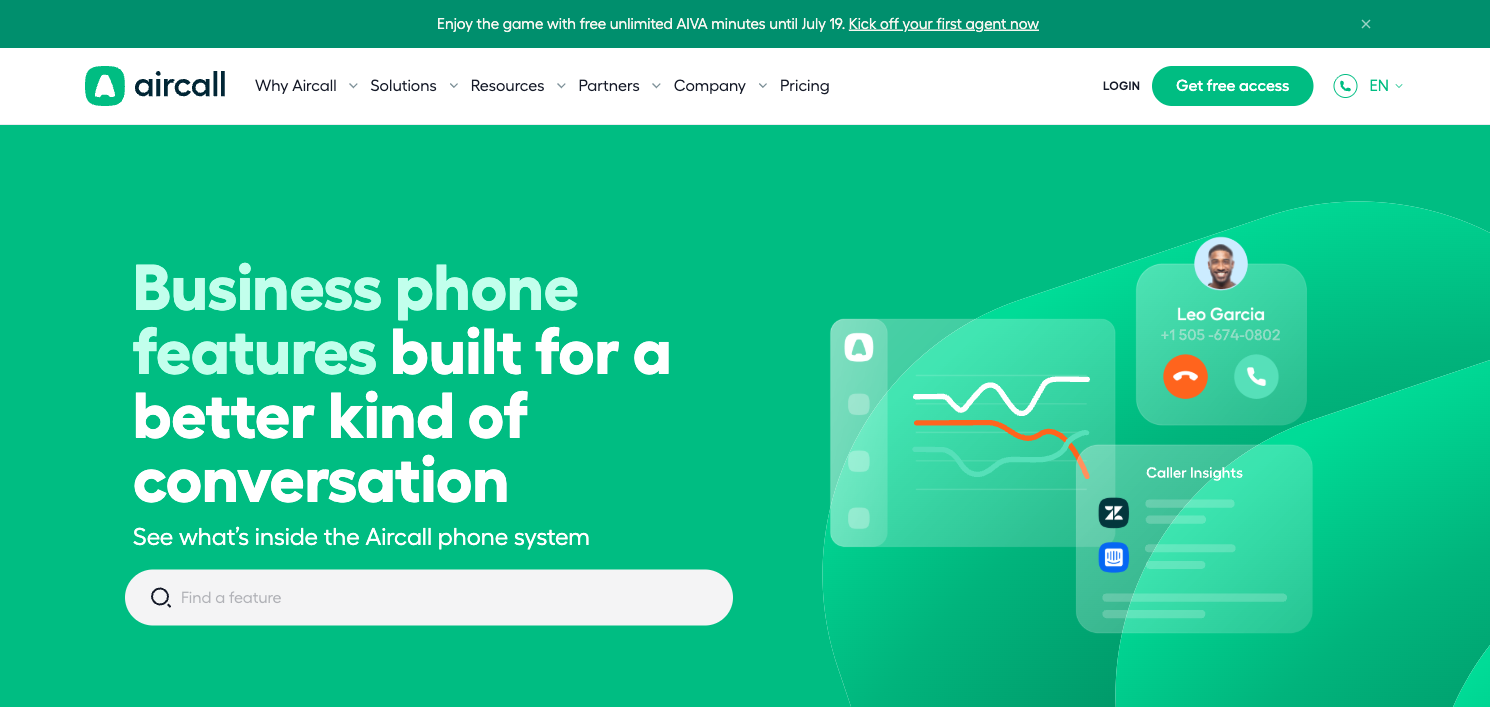
- Agent — answers inbound and outbound calls from the Aircall Phone app on desktop or mobile, with contact history pulled from HubSpot, Pipedrive, Salesforce, Zendesk or Intercom via native integration.
- Supervisor — watches active calls, wait times and abandoned queues in Aircall Analytics+, listens in silently or steps into a call with the Live Feed view.
- QA analyst — reviews call recordings tagged to the CRM record, scores agent conversations against custom quality criteria in Aircall AI, and shares coaching snippets directly with the agent.
- WFM manager — plans agent shift coverage by team and by number, reviews per-agent talk-time and wrap-time trends, and adjusts routing IVRs to match peak-hour patterns.
- IT / telecom admin — adds phone numbers in 100+ countries in minutes from the Aircall admin, enforces SSO through Okta or Google Workspace, and provisions new agents without touching a PBX.
Unified agent desktop and cross-channel history
Aircall is voice-first, and the omnichannel story runs through the CRM the customer is already in. A voice interaction in Aircall writes back to the Salesforce or HubSpot contact record automatically, so a follow-up email from the customer surfaces the earlier call in the same activity feed. The agent works inside the CRM they already know; the CRM becomes the unified history.
Estimate your Aircall cost
Uses published $30.00/seat/mo (Essentials) starting rate. Updates as you type.
Estimator uses vendor-published list rates as anchor. Actual quotes vary by add-ons (AI, WFM, dialer minutes) — request a written quote before signing.
Book a Aircall demo
Vendor-facilitated. We forward your request to their sales team within 24 hours.
- Choose a preferred date + time slot
- 30-minute product walkthrough
- Custom pricing based on your seat count
Screenshots
Pros
- Fast self-serve onboarding
- 100+ native CRM/helpdesk integrations
- Transparent published pricing
Cons
- Limited omnichannel — voice-primary with light SMS/WhatsApp
- No native predictive dialer
- Enterprise features (WFM, QA) absent
Similar Contact Center Core Tools
User Reviews
Write a reviewNo reviews yet for Aircall.
Be the first to review