
Avaya Experience Platform (AXP) and Avaya Infinity are two distinct, simultaneously active product lines in 2026, not one product under a rebrand. Avaya Infinity launched April 22, 2025 as a separate cloud-native re-platforming, and AXP Public Cloud customers are now receiving “evolution notices” indicating SKU transition timelines. Avaya emerged from its second Chapter 11 in May 2023 under Apollo and Brigade Capital ownership, with approximately $650 million in debt and under 1x net leverage, a meaningfully healthier capital structure than pre-bankruptcy. Avaya did not appear in the September 8, 2025 Gartner Magic Quadrant for CCaaS.
This review covers what Avaya is in 2026 after the post-bankruptcy reset, how the AXP versus Avaya Infinity coexistence affects your evaluation, where the compliance posture sits (with SOC 2 Type II notably absent from the public Trust Center summary), and the documented limitations every Avaya-installed-base evaluation should weigh.
Company facts: private, post-Chapter 11, Apollo + Brigade ownership
Avaya is a private company headquartered in Morristown, New Jersey. The company has filed Chapter 11 twice: first in January 2017, then again in February 2023. Avaya emerged from the second Chapter 11 filing in May 2023 under Apollo Global Management and Brigade Capital Management ownership.
The post-bankruptcy capital structure is meaningfully healthier than pre-bankruptcy. Apollo and Brigade Capital reset the debt load at approximately $650 million with under 1x net leverage. The financial fragility that defined Avaya across 2017-2023 has been addressed at the balance-sheet level, though revenue trajectory and customer-retention metrics are not publicly disclosed at private-company granularity.
Avaya does not disclose customer count, revenue, or specific employee figures on a recurring basis. Pre-bankruptcy claims (“100,000+ customers, 90% of Fortune 100”) are stale and should not be cited as current in 2026 evaluations. Verify current state directly with the Avaya account team rather than relying on third-party aggregator data.
AXP and Avaya Infinity: distinct active products, not a rebrand
The structural fact every Avaya CCaaS evaluation must understand: AXP (Avaya Experience Platform) and Avaya Infinity are two distinct active product lines in 2026.
AXP is the existing cloud product, launched as the migration target for Avaya Aura and other on-premise contact center estates. The product runs on a hybrid cloud architecture and has been the primary Avaya CCaaS offering since 2022.
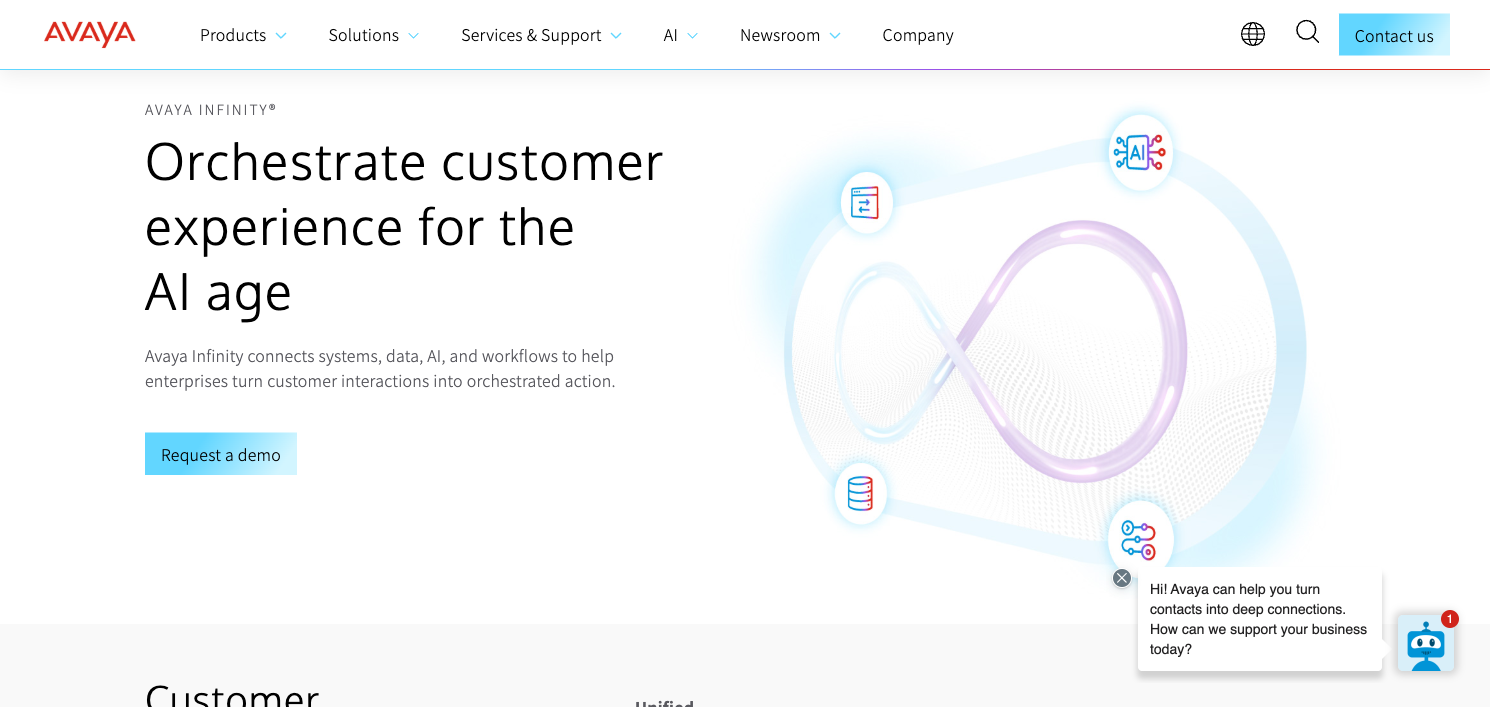
Avaya Infinity launched April 22, 2025 as a cloud-native re-platforming. It is NOT a rebrand of AXP. It is a separate product line with different architectural foundations, different roadmap commitments, and different commercial terms. AXP Public Cloud customers are receiving “evolution notices” from Avaya indicating SKU transition expectations, but the two products remain simultaneously sold.
For your evaluation, the implication is structural. Buyers signing AXP contracts in 2026 are buying a product that Avaya itself is signaling will transition. Buyers signing Avaya Infinity contracts are buying the longer-strategic-roadmap product but with shorter production deployment history. Verify with your Avaya account team which product is being quoted and what the transition timeline commitment looks like.
Pricing: sales-gated across AXP and Avaya Infinity
Avaya does not publish per-seat list pricing for AXP or Avaya Infinity on its public website. Both products require sales engagement.
Third-party 2026 breakdowns place AXP per-user per-month pricing in a wide range depending on tier, channel mix, and migration scope. The figures are planning estimates only; they are not Avaya-published.
For your evaluation, you cannot model Avaya CCaaS cost from public information. Request itemized quotes for both AXP and Avaya Infinity during sales engagement, and verify the long-term commitment cost for the product line Avaya expects to remain the strategic platform.
Compliance: certifications scoped per product line, SOC 2 Type II absent from public Trust Center
The compliance detail that catches buyers off-guard: Avaya’s Trust Center scopes each certification by specific product line rather than at the company level.
| Certification | Scope (per Avaya Trust Center) |
|---|---|
| ISO 27001 | AXP Public, AXP Private with AEC, Avaya Managed Services Platform |
| FedRAMP | Avaya Government Cloud (only) |
| HIPAA-BAA | Verify per SKU |
| PCI DSS | Verify per SKU |
| SOC 2 Type II | NOT listed on public Trust Center summary |
The SOC 2 Type II absence is structural. The Trust Center compliance summary does not surface SOC 2 Type II as a company-wide certification or as an explicit AXP / Avaya Infinity credential. Other 2025 catalog vendors (NICE, Five9, Talkdesk, RingCentral) list SOC 2 Type II prominently on their public Trust Centers.
For your evaluation, do not assume Avaya holds SOC 2 Type II at the application layer for AXP or Avaya Infinity. Verify with the Avaya account team per specific SKU. The certification may exist behind sales engagement, but it is not publicly enumerated.
FedRAMP authorization is scoped specifically to Avaya Government Cloud, not the broader AXP or Avaya Infinity product lines. Federal-procurement-led evaluations should verify the specific product SKU that carries the FedRAMP authorization rather than assuming AXP or Avaya Infinity inherit the credential.
2025 Gartner positioning: not in the CCaaS MQ
Avaya did not appear in the 2025 Gartner Magic Quadrant for CCaaS. The absence is structural: Gartner’s CCaaS MQ targets cloud-native CCaaS evaluations, and Avaya’s mid-flight cloud transition (AXP plus Avaya Infinity coexistence) does not fit the survey scope cleanly.
The 5 Leaders in 2025 are NICE, Genesys, Five9, Talkdesk, and AWS Amazon Connect. Avaya appears in adjacent analyst coverage of contact center modernization and on-premise migration but not in the 2025 CCaaS Leaders, Visionaries, Challengers, Niche Players, or Honorable Mentions on this specific Magic Quadrant.
For procurement evaluations weighting analyst placement, the MQ absence matters. For Avaya-installed-base buyers focused on migration off Avaya Aura, the analyst placement is less determinative than the migration tooling depth.
Channel coverage and product portfolio
Avaya AXP and Avaya Infinity cover the standard CCaaS channel set: inbound voice, outbound voice with dialer modes, email, web chat, SMS, and social messaging integration. The platform’s voice infrastructure is the longest-tenured in the catalog, built from Avaya’s decades of on-premise telephony engineering.
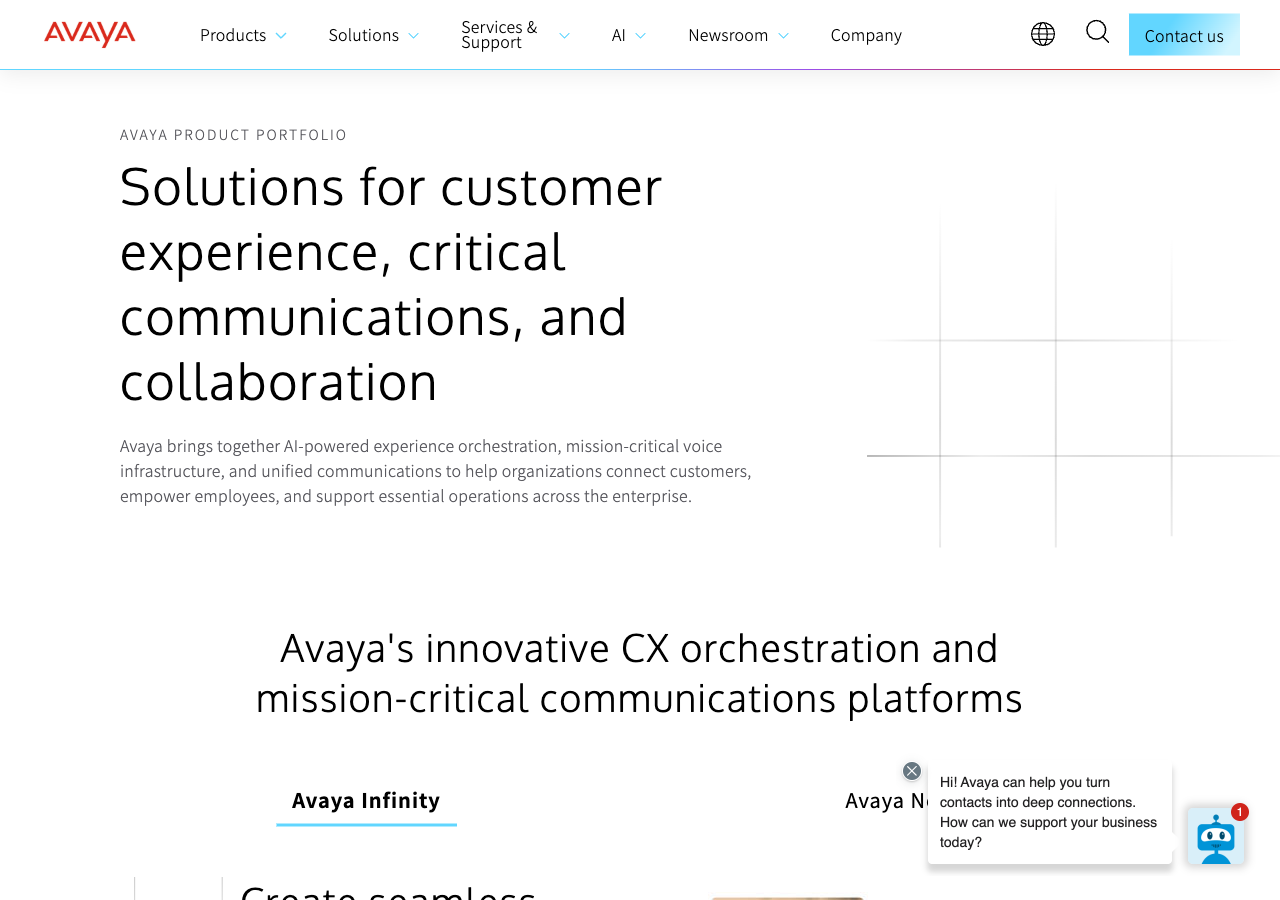
The product surface in 2026 spans Avaya Aura (on-premise legacy CC), AXP (existing cloud product), Avaya Infinity (April 2025 cloud-native re-platforming), Avaya Government Cloud (FedRAMP-scoped), Avaya Managed Services Platform, and supporting workforce engagement management products.
The Apollo and Brigade Capital ownership has funded the Avaya Infinity development. The strategic direction of the company is consolidating onto the new cloud-native platform while maintaining AXP for installed-base customers. The pace of the consolidation will determine whether AXP buyers in 2026 face a managed transition or a forced one.
Where Avaya still falls short
A vendor-neutral review names the gaps. Avaya has four documented limitations that should sit in your evaluation matrix.
AXP and Avaya Infinity coexistence creates SKU confusion. Two distinct active products with different architectures and different roadmap commitments require explicit verification of which one your contract covers. The “evolution notices” framing for AXP Public Cloud customers signals strategic transition expectations.
SOC 2 Type II absent from public Trust Center summary. Procurement security reviews requiring application-layer SOC 2 mapping cannot verify from public information. Allocate time for vendor-side certification confirmation per SKU during evaluation.
Two Chapter 11 filings in six years. January 2017 and February 2023. The post-bankruptcy capital structure is meaningfully healthier, but the financial history remains in long-term procurement risk models. Verify Apollo and Brigade Capital exit plans during evaluation if your contract horizon extends beyond 2027.
Not in the 2025 Gartner CCaaS MQ. Procurement evaluations weighting analyst recognition should know the absence. Buyers wanting Magic Quadrant validation should look at the 5 Leaders instead.
How Avaya compares with the 2025 Leaders
Avaya vs NICE CXone. NICE is a 2025 Leader (11th year, highest Ability to Execute, $328M AI ARR +66%, FedRAMP Moderate). Avaya is not on the 2025 CCaaS MQ. NICE for enterprise WFM-led evaluations; Avaya for Avaya installed-base migration.
Avaya vs Genesys Cloud CX. Genesys is a 2025 Leader (11th year, $250M+ AI ARR, ISO 42001 cert, expected 2026 IPO). Avaya is not on the 2025 MQ. Genesys for enterprise omnichannel; Avaya for Aura migration.
Avaya vs Cisco Webex Contact Center. Both target on-premise migration buying motions (Avaya for Aura, Cisco for UCCX/UCCE/HCS). Both gate pricing. Both 2025 MQ-thin (Cisco Niche Player, Avaya absent). Both Trust Center scopes per product line.
Avaya vs AWS Amazon Connect. Amazon Connect is a 2025 Leader (3rd year) with $0.018-$0.038 per-minute consumption pricing and FedRAMP via AWS. Avaya is sales-gated per-seat with FedRAMP scoped specifically to Avaya Government Cloud.
The bottom line for an Avaya installed-base evaluator
Avaya AXP and Avaya Infinity are the structural pick when migrating off Avaya Aura or other Avaya on-premise contact center estates is the strategic constraint. The migration tooling depth, existing partner relationships, dial plan compatibility, and IT operations skills transfer materially smoother than re-platforming to a non-Avaya vendor. The post-Chapter-11 capital structure under Apollo and Brigade Capital is meaningfully healthier than pre-bankruptcy.
The cost is the AXP / Avaya Infinity coexistence requiring SKU verification, the SOC 2 Type II absence from public Trust Center, the FedRAMP scope limited to Avaya Government Cloud, the absence from the 2025 Gartner CCaaS MQ, and the lingering procurement-risk weight of the two Chapter 11 filings.
For Avaya installed-base enterprises with strategic constraints requiring on-premise to cloud migration without a vendor change, AXP or Avaya Infinity belongs on the shortlist. For greenfield CCaaS evaluations or procurement teams weighting analyst placement, the 2025 Leaders fit better.
Verify which product line (AXP or Avaya Infinity) your specific quote covers, the transition timeline commitments for AXP Public Cloud customers, and per-SKU compliance certification scope directly with your Avaya account team. The two-product coexistence in 2026 creates real evaluation complexity that does not exist at single-product competitors.
Methodology
This review draws from the Avaya official site, the April 22 2025 Avaya Infinity launch announcement, the Avaya Trust Center compliance summary, the post-Chapter 11 emergence documentation from May 2023.
Verification process: AXP versus Avaya Infinity distinction was verified directly on Avaya product pages. The compliance certification scoping per product line was verified against the public Trust Center. Pre-bankruptcy customer claims were noted as stale and not asserted as current.
For category context, see What is CCaaS and Cloud Contact Center. For 2025 Gartner Leaders, see NICE, Genesys, Five9, Talkdesk, and Amazon Connect.
What each role sees on Avaya
- Agent — handles voice and digital interactions in the Avaya Experience Platform (AXP) Agent Desktop with case history from Salesforce or ServiceNow displayed on the screen pop.
- Supervisor — monitors live queues, service levels and agent state in AXP Real-Time Analytics, joins calls in silent monitor or coaching mode, and reassigns work between teams from the same view.
- QA analyst — auto-scores conversations with AXP Conversational AI, evaluates recordings against custom scorecards, and routes coaching alerts to the supervisor when performance dips.
- WFM manager — forecasts contact volume and builds multi-skill schedules in Avaya Workforce Engagement, tracks adherence, and reruns forecasts when actuals drift.
- IT / telecom admin — runs AXP as pure-cloud, hybrid or on-premise (unique in the 2026 catalog), preserves existing SIP trunks and Avaya Aura investments, and centralises identity through Microsoft Entra ID or Okta.
Unified agent desktop and cross-channel history
Avaya Experience Platform threads voice, email, chat, SMS and messaging into a single agent view, so a customer who called yesterday and messaged today lands with the same agent whose history is already loaded. The desktop retains context across channel switches; the supervisor sees the same threaded conversation and can escalate to a subject-matter expert without breaking the customer's session.
Estimate your Avaya cost
Uses published $100.00/seat/mo starting rate. Updates as you type.
Estimator uses vendor-published list rates as anchor. Actual quotes vary by add-ons (AI, WFM, dialer minutes) — request a written quote before signing.
Book a Avaya demo
Vendor-facilitated. We forward your request to their sales team within 24 hours.
- Choose a preferred date + time slot
- 30-minute product walkthrough
- Custom pricing based on your seat count
Screenshots
Pros
- Huge installed base of large enterprise contact centers
- AXP keeps existing Avaya investment alive
- Deep PSTN and contact center DNA
Cons
- Cloud migration path complex
- Two Chapter 11 filings (2017, 2023) raise concerns
- Product roadmap pace slower than cloud-native peers
Similar Contact Center Core Tools
User Reviews
Write a reviewNo reviews yet for Avaya.
Be the first to review